Tonality: tracks, harmonicity, and key
Much of what makes a soundscape recognisable is tonal: a mains hum, a bell
partial, a beep, a distant engine, a voice. ambiscape tonality reads the
cached per-minute mean spectrum and reports the tonal content four ways:
the narrowband tonal peaks, those peaks linked across minutes into tracks,
how harmonic the content is, and what "key" the place hums in.
ambiscape tonality <session-folder> # needs a prior analyze run
Works entirely from the cache, with no audio pass. Writes tonality.json
(tracks, tonalness_median, harmonicity_median, inharmonicity_median,
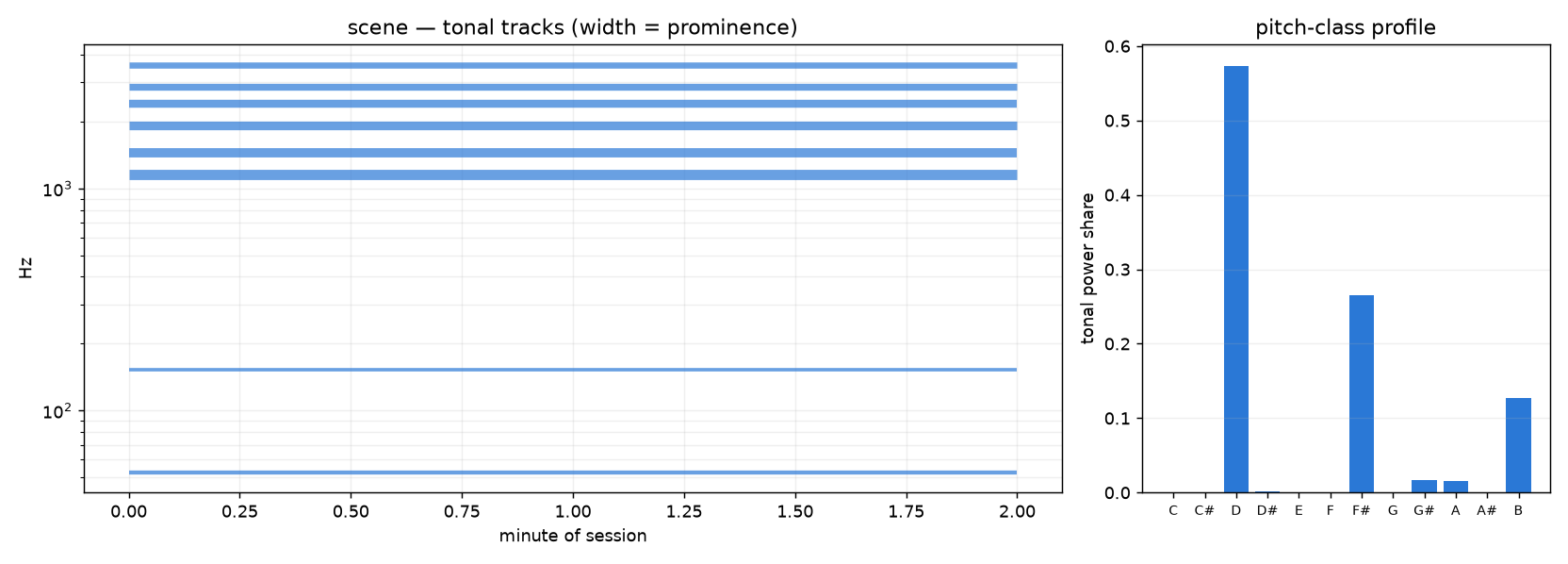
a 12-bin pitch_class_profile and top_pitch_classes) and tonality.png
(the tonal tracks over session minutes beside the pitch-class bars).
The four layers
- Tonal peaks: narrowband components rising a set prominence (default 8 dB) above a running spectral floor, the raw material.
- Tonal tracks (
tonal_tracks): peaks linked across minutes into tracks, each withf_median_hz, its span of minutes, meanprominence_db, anddrift_cents. A steady hum is a long flat track; a warming engine drifts. - Harmonic sieve (
harmonic_sieve): the best f0 that explains a minute's peaks as a harmonic series k·f0.harmonicityis the explained power fraction;1 − harmonicityis the inharmonicity index. Voices, engines and music score high; bells score low, since their partial series (roughly 1 : 2 : 2.4 : 3 : 4) is not harmonic. - Pitch-class profile (
pitch_class_profile): tonal peak energy folded onto the 12 pitch classes (A4 = 440 Hz), or what note the soundscape sits on.
In Python
from ambiscape import tonality

tracks = tonality.tonal_tracks(minspec, freqs)     # sorted longest-first
f0, harmonicity = tonality.harmonic_sieve(fq, power)
pcp = tonality.pitch_class_profile(minspec, freqs)  # 12-vector, sums to 1
Read harmonicity_median beside the carillon and rhythm analyses: a low
median with strong tonal tracks is the signature of bell-like, inharmonic
sources, and a high median points to voices, engines, or music.
One source, interrupted, is several tracks
lines = tonality.group_tracks(tracks) # tol_cents=60 by default
tonal_tracks answers how long a line was continuously present. A machine
that pauses, or changes speed and comes back, is correct as several tracks and
misleading as a description of the source: a dishwasher's circulation pump
appears as five. group_tracks merges segments within tol_cents of each
other into one line, with the total minutes, the number of segments, and the
span from first to last. On that kitchen night it takes the pump's five
segments to one line of 114 minutes, and the session's 70 tracks to 14 lines.
Grouping by frequency alone is the assumption: two unrelated sources sharing a frequency merge, and a source that moves further than the tolerance between segments does not. Use it to count lines, not to attribute them.
On machinery, change all three defaults
harmonic_sieve is tuned for voices and music, and its parameters choose
between defensible answers rather than merely setting precision. A
dishwasher's circulation pump, whose strong low peaks put its shaft near
46 Hz, shows each:
| parameter | default | what it gives on the pump |
|---|---|---|
f0_min |
60 Hz | above the shaft, so the second harmonic, 91.9 Hz |
tol_cents |
35 | a different fundamental, 68.6 Hz at harmonicity 0.73 |
max_harm |
12 | short for a comb tracked to k = 26 |
The tolerance is the one to watch, because a cents window is proportional: 35 cents is ±5.6 Hz at 275 Hz but ±17 Hz at 825 Hz, wide enough to collect high harmonics by coincidence. The loose fit above scores higher than the tight one, 0.73 against 0.45, while explaining nine of twenty-seven peaks rather than fourteen, fitting the strongest peak less exactly and missing the second-strongest by two semitones.
f0, harmonicity = tonality.harmonic_sieve(
    fq, power, f0_min=40.0, tol_cents=8.0, max_harm=28)
Quote a harmonicity with the tolerance it was computed at. On its own it does not say which series was chosen.