Sessions and conventions
The session model
A session is a folder of WAV files. ambiscape parses each file's BWF bext
chunk natively (no ffmpeg needed) for its origination date/time, and places
all takes on one absolute clock, counting seconds since the session's
first midnight. Recorder splits (2 GB FAT limits) chain seamlessly. Genuinely
separate takes (a gap larger than ten minutes) stay on the same clock
but render as separate panels in figures, since a morning walk and an
evening one belong to the same day without belonging to the same scene.
Sessions vs. scenes
The folder-as-session model assumes every WAV in a folder belongs to one
recording occasion. A contributed corpus is often the opposite: one folder
per recordist, each holding many independent one-off scenes from
different places and dates. Open a single recording as its own scene with
open_recording(path) (day0 = that file's BWF date, name = the file stem),
or analyse a whole folder of them in one call:
ambiscape scenes CONTRIB/Microphone_1/   # one summary per WAV, keyed by filename
ambiscape catalog CONTRIB/Microphone_1/analysis/scenes/   # then compare them
Each scene is written as a catalogue-ready mini-session, so catalog and
longitudinal work across them unchanged.
read_span(session, t0, dur) returns raw audio from anywhere on that
clock, transparently crossing file boundaries.
Channel order: AmbiX vs FuMa
The Zoom H3-VR records first-order B-format in either AmbiX (ACN order
W, Y, Z, X; SN3D) or FuMa (W, X, Y, Z) mode. ambiscape reads the
recorder's zTRK tags from the bext description and sets the channel map
per take (io.channel_order). This matters: processing AmbiX data with a
FuMa map feeds the near-empty Z channel into the horizontal decode and
collapses all azimuth estimates onto a 0°/180° axis.
Warning
For B-format files of unknown provenance, check each take with
io.channel_order, which reads the recorder's zTRK tags. An azimuth
distribution that hugs one axis across different rooms is the
tell-tale sign of a convention mismatch.
Direction conventions
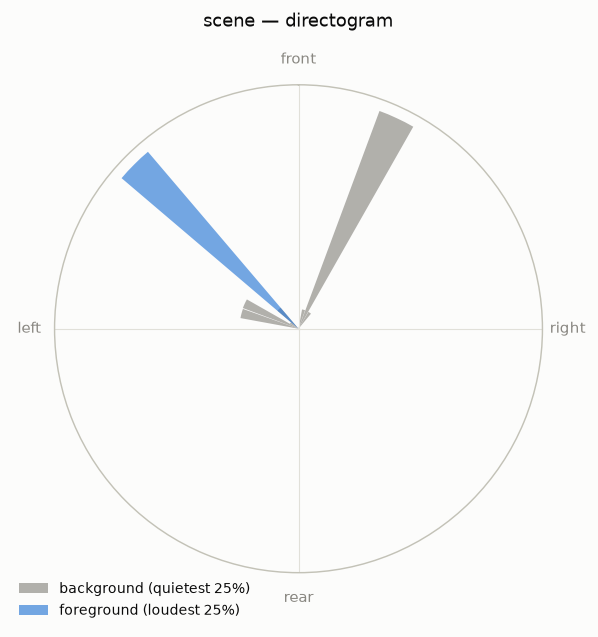
- Azimuth: 0° = front (X+), +90° = left (Y+), ±180° = rear (anticlockwise positive). Elevation: positive up.
- All directions are microphone-relative. If you need world bearings, record the mic's orientation in the field (compass reading of the X+ axis, or calibration claps from known positions; see the wiki protocol).
Levels
Levels are dBFS (uncalibrated) unless a calibration.json provides a
dbfs_to_dbspl offset. Within-session structure is exact either way;
between-session absolute comparisons without calibration are indicative
only.