Mains hum and the grid frequency (ENF)
Indoor recordings hum with the electricity supply: 50 Hz (nominal, Europe)
and harmonics, with magnetostriction strongest at 100 Hz. The grid's
actual frequency wanders by tens of millihertz as load and generation
balance, and that wandering value is the electric network frequency, or
ENF. A long recording carries the wander as a continuous, involuntary log
of the grid. The enf module reads it; a whole night of domestic hum
tends to track the grid to within tens of millihertz.
ambiscape enf SESSION/ --nominal 50 # 60 in the Americas
--step and --win set the seconds between windows (default 300) and
the window length (default 60); the command writes enf.json and
enf.png into analysis/.
The cached per-minute spectra are far too coarse for this (5.9 Hz bins);
ambiscape.enf makes its own pass over the raw W channel.
Tracking
from ambiscape import enf

tr = enf.enf_track(sess, step_s=300, win_s=60, harmonics=(1, 2))
enf.enf_summary(tr)
# {'mean_hz': 49.9958, 'sd_mhz': 21.0, 'max_dev_mhz': 88.0,
#  'coverage': 1.0, 'harmonic_agreement_mhz': 0.9, ...}
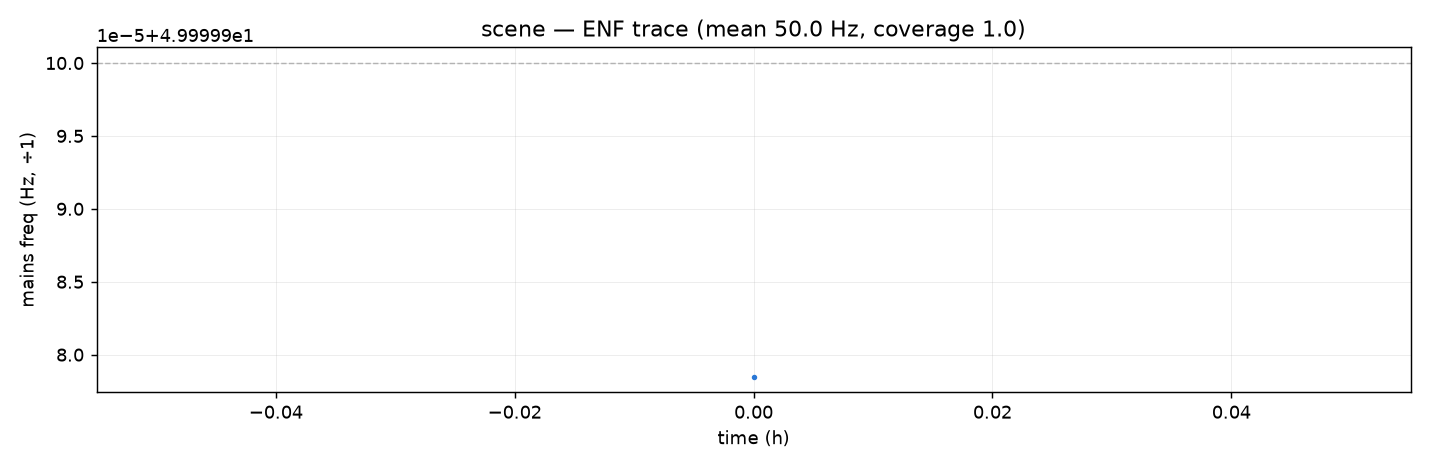
hum_peak measures one window (zero-padded FFT + parabolic interpolation
→ millihertz precision on a 60 s window); enf_track walks a whole
session, skipping the sliver reads that recorders' overlapping 2 GB splits
produce at take boundaries.
Reading the summary
harmonic_agreement_mhzis the authenticity check: the 50 Hz and 100 Hz hum are independent acoustic lines driven by the same electrical frequency, so millihertz agreement confirms you are looking at the grid and not at a machine. In Haarlem a second stable line at ~49.8 Hz—a rotor just under synchronous speed—masqueraded as mains in coarse spectra; its wander was 17× the grid's and it tracked nothing.- A Continental-Europe trace should sit near 50.000 Hz with SD ~20 mHz, rarely leaving ±50 mHz (the ENTSO-E normal band). Systematic offsets mean either a mechanical line or a recorder sample-clock error.
- Forensics: matched against published grid-frequency archives, an ENF
trace timestamps a recording to the second, independently of the
recorder clock, which gives a cross-check for
schedule.clock_offset.
Pickup or hum in the air
A recorder on a USB supply can take the mains in through the cable. That hum
is electrical, not acoustic, and it reaches every capsule of a B-format
microphone in phase, so after the A- to B-format matrix it lands in W and
hardly at all in X, Y and Z. Hum in the air has a direction, or spreads over
all directions, and fills the first-order channels too. supply_signature
measures that difference for each mains harmonic:
ambiscape supply SESSION/                 # analysis/supply.json, one entry per take
ambiscape supply SESSION/ --bearing 100   # also the bearing of the 100 Hz line
sig = enf.supply_signature(take.audio_path, wyzx=take.wyzx)
sig["verdict"]                     # 'pickup', 'acoustic', 'no line', 'not ambix' or 'empty'
sig["fundamental"]                 # {'prom_W_db': 16.8, 'line_minus_ring_db': -15.1, ...}
prom_W_db is how far the line stands out of the spectrum in W
(tonality.narrow_line_prominence). line_minus_ring_db is the line's excess
power in X, Y and Z against W, in dB, minus the same ratio for the noise just
beside it; subtracting the surround removes what the recorder and the room do
to every frequency alike, so a line in the air sits near 0 dB and pickup far
below. The verdict is pickup when the fundamental stands at least 6 dB out
and sits at or below −10 dB.
The threshold rests on little. On an overnight Zoom H3-VR session with its USB adapter beside it, the 50 Hz line stood 13.8 to 16.8 dB out and sat 15.1 to 18.5 dB below its surround, while tracking the grid; across 45 other H3-VR files on batteries, a power bank or another USB supply, no 50 Hz line reached 10 dB, and where one stood out by 6 dB its direction ratio was within −5.5 to +3.7 dB of the surround. USB power alone does not make pickup; the adapter, the socket and the cable do. A pickup line also passes every ENF test, since it is the grid: the direction ratio is what tells the cable from the room.
line_bearing(path, f0) gives the bearing of a steady line from the active
intensity at f0 (the real parts of the cross-spectra of W with X, Y and Z),
summed over six windows and kept per window, so a fixed source shows as a
bearing that does not move. In the same night the 100 Hz line, twice the mains
frequency where transformers hum, pointed to 168 to 170° and 14° below the
capsules in every take, where the power adapter stood on the table: the supply
reached the recording twice, through the cable at 50 Hz and through the air at
100 Hz.
As a corpus descriptor
enf_summary's median_rise_db and coverage say how electrified a room
sounds: a machine-room measured +45 dB of 50 Hz line, a quiet hotel room
essentially none. Compare across sessions before interpreting any
low-frequency tonal finding, since the hum is in nearly every indoor
recording.
Coverage is not a location proxy
It is tempting to read coverage as proximity to mains, and so as a
physical check on whether a session happened indoors. It does not work.
Across 365 daily recordings sorted into seven kinds of place, the group
medians ran from 0.590 down to 0.475 — a total range of 0.115 against a
within-group interquartile width of 0.260, with Kruskal–Wallis
returning H = 3.7 at p = 0.72. Outdoor and semi-open sessions ranked
sixth of seven, in among the indoor groups rather than below them.
Nothing was wrong with the ENF measurement over that year: the grid was
recovered on 364 of 365 days at a median 49.9913 Hz. What coverage
tracks is the recording — gain, wind, the recorder's own floor — not
the room. It is also a fraction of windows clearing a threshold, so it
depends on win_s, step_s and min_rise_db, and two coverages are
comparable only where all three match.
A between-group difference means nothing until it is put beside the within-group spread. And a single extreme day deserves a look at the file before it is believed: the lowest reading of that year came from a WAV whose header declared 690 seconds over 379 MB of audio and returned no frames at all to libsndfile, without raising anything.