Strike-level rhythm
ambiscape rhythm <session-folder> analyses the rhythm of quasi-periodic
pitched sources such as swinging or chimed bells, machine cycles and
repeated signals, at strike resolution (~20 ms), far below the 1 Hz grid of
the standard features. It needs a prior analyze run (it starts from the cached per-minute
mean PSD).
 The
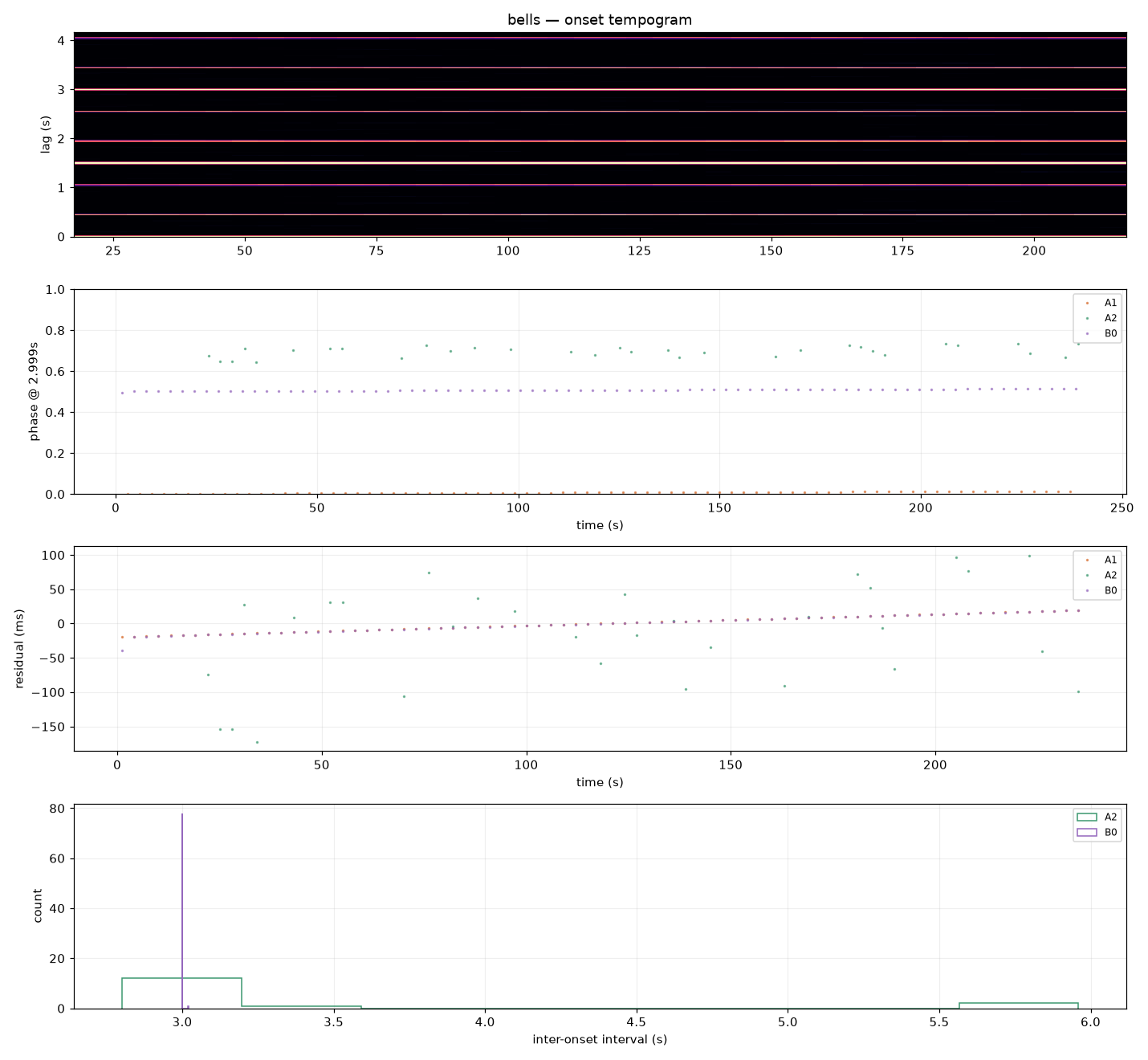
The rhythm_overview.png four-panel figure: the onset tempogram (candidate
periods over time), the strike phases folded at the recovered cycle, the
per-cycle residual grid, and the inter-onset-interval histograms per stream.
Pipeline
- Partials: narrowband peaks of the source(s), found by contrasting the
mean spectrum of source-active minutes against quiet minutes
(
rhythm.detect_partials). Active/quiet minutes are auto-detected from 1–2 kHz octave power (2-means threshold) or overridden with--stop. - Streaming pass: one extra pass over the audio storing, per 20 ms
frame, the power envelope and pseudo-intensity at each partial plus a
broadband onset function (
rhythm.partial_pass). - Sources: partials are grouped into sources by correlating their
rectified log-envelope derivatives: partials that rise together belong to
the same strike stream (
rhythm.cluster_partials). - Strikes: adaptive strongest-first onset picking per source, with the
separation guard derived from the onset-function autocorrelation
(
rhythm.acf_structure,rhythm.pick_strikes) so weak between-strike peaks are rejected without a fixed threshold. - Periodicity: the cycle period from a Rayleigh point-process
periodogram (resultant length over a period grid, harmonics included for
multi-strike cycles), refined near the ACF fundamental to avoid
subharmonics; sliding-window period track for drift
(
rhythm.best_period,rhythm.period_track). - Repetition vs. variation: strikes are folded into phase clusters
(
rhythm.phase_clusters) and laid on a rigid cycle grid (rhythm.cycle_grid): per-position hit rates, timing SD, slow wander vs. cycle-to-cycle jitter, lag-1 autocorrelation. - Verification:
rhythm.rise_spectrumcomputes the strike-triggered post/pre spectral rise of any stream: a stream whose rise spectrum shows another source's partials is cross-talk, not an independent strike (such clusters are flagged ascrosstalk_suspectsinrhythm.json).rhythm.strike_doagives per-stream azimuth/elevation from the pseudo-intensity at the source's own partials.
Output
analysis/rhythm_overview.png (onset tempogram, phase fold, cycle-grid
residuals, IOI histograms) and analysis/rhythm.json (per-source partials,
period, phase clusters, DOA, per-position variation statistics, plus
circular statistics: per-stream phase_stats—R, circular SD, Rayleigh
p—and phase_lock, the per-strike relative phase between sources'
primary streams; R near 1 with a small circular SD means the sources are
mechanically phase-locked).
Swing verification (rhythm.partial_fm)
A genuinely swinging bell Doppler-modulates its partials by a few cents at
the swing period; a chimed bell does not. partial_fm tracks a partial's
instantaneous frequency and demodulates at the cycle rate against an
off-rate control. In the Haarlem case study both bells show cycle-rate FM
20–70x above control (2.4 and 1.3 cents at the nominals). Both bells
physically swing, which makes their millisecond phase lock a genuine
mechanical-synchronisation observation.
Informed prior (distant / low-SNR sources)
Blind partial detection needs the source to dominate the active-vs-quiet spectral rise. At two blocks' distance, under birds, bikes and traffic, it fails, since foreground events swamp the rise. Supply a fixed prior instead:
ambiscape rhythm <folder> --prior damiaatjes_prior.json --k 3.5 --min-gap 0.42
where the JSON carries a known partial list and A/B grouping:
{ "partials_hz": [475.1, 597.7, 920.2, 1130.9, 1359.4, 1910.2, 2302.7, 2882.8],
  "groups": { "A": [475.1, 920.2, 1130.9], "B": [597.7, 1359.4, 2302.7] },
  "strike_k": 3.5, "min_gap_floor": 0.42 }
This bypasses detect_partials (the list becomes the tracked partials) and the
blind clustering (the grouping is fixed), while strike_k raises the
onset-picking threshold and min_gap_floor guards the intra-cycle
separation, and both stabilise picking when the strike ODF is noisy.
rhythm.json records the
prior and a _method_note. The library call is
rhythm.run_session(sess, out, partials=[...], groups={...}, strike_k=3.5,
min_gap_floor=0.42)
. The prior is reusable across sessions of the same source:
the Damiaatjes prior derived from the close 2026-07-17 recording drives the
distant 07-18 and 07-21 analyses unchanged.
Caveats
- Sources sharing most of their partials (unison bells) will merge into one
stream; check
crosstalk_suspectsand the rise spectra before interpreting phase clusters as physical strikes. Coincident clusters are flagged on both sides, so userise_spectrumon each to decide which one is the real strike (the artifact's rise spectrum shows the other source's partials). - Per-partial DOA in reflective environments (street canyons) is frequency-dependent; treat per-source azimuths as sector estimates, not bearings.
- Everything runs on the W channel except pseudo-intensity (AmbiX ACN W/Y/Z/X, as elsewhere in ambiscape).