ambiscape
A holistic toolbox for analysing soundscapes, the sonic ambiences of rooms, streets, and landscapes, from any recording: mono, stereo, binaural, or first-order ambisonic. It brings level, spectral, spatial, temporal, ecological, and source-domain descriptors into one picture, and streams recordings of any length (minutes to whole nights) in constant memory. It is built for several kinds of reader at once: acousticians and soundscape ecologists, sound artists and composers, students, and anyone curious about the sound of a place.
Why
Most audio analysis tooling assumes a file you can load whole. Long-form field recording produces something else: tens of gigabytes per session, split into 2 GB files by the recorder, in which the interesting structure lives at time scales of minutes to hours, such as machine duty cycles, diurnal traffic envelopes and day/night state changes. The session—a folder of WAVs on one absolute clock—is therefore the unit of analysis, and ambiscape produces:
- descriptors in the environmental-acoustics idiom (Leq, LAeq, L10/L50/L90, event statistics), with a sensor-noise-floor guard that flags bands whose low-percentile levels measure the recorder's self-noise rather than the room,
- spatial timelines when the recording carries direction: full direction of arrival, diffuseness and azimuthal concentration from ambisonics, a lateral left/right cue from stereo,
- source decomposition: geophony, biophony, anthrophony, and mechanical/transport indices, plus two separate annotation layers, one for Schaeffer's typo-morphology and one for Schafer's soundscape functions,
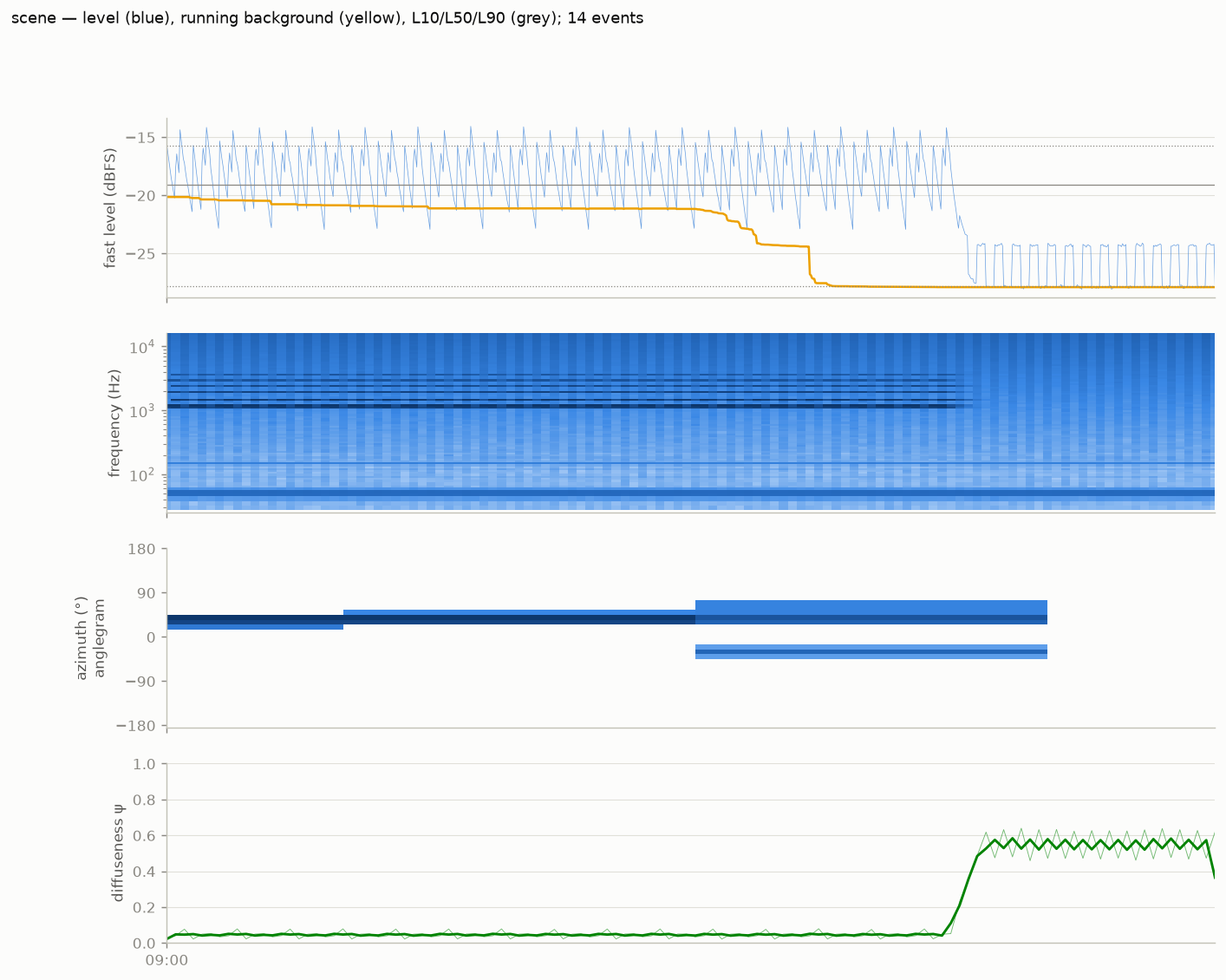
- figures (session overview, percentile spectra, directograms, taxonomy maps and timelines),
- room acoustics: T60 from claps or incidental impulses, swept-sine impulse-response measurement (T60/EDT, clarity, STI, IACC), and auralization through a measured room,
- machine states: on/off segmentation, duty cycles, source spectral fingerprints, and targeted civic-grid scans (church clocks, sirens),
- mains hum / ENF: millihertz tracking of the electric network frequency for grid forensics and hum characterisation,
- ratings & global indices: NR/NC/RC room criteria, intermittency ratio and emergence, the ecoacoustic battery (ACI, ADI/AEI, NDSI, BI, H), EDT/C50/C80/D50, and spatial descriptors (directional entropy, horizon fractions, foreground/background direction overlap),
- biophony: structural measures of nature/animal sound (narrowband activity, temporal entropy, spatial dispersion) plus an optional BirdNET species layer gated to hi-fi windows,
- strike-level rhythm of quasi-periodic sources such as bells and machines, with periodicity, phase, and repetition-vs-variation statistics,
- ISO 12913-3 psychoacoustic indicators and a calibration hook,
- ISO 12913-2 perceptual surveys: Method-A questionnaire responses projected onto the 12913-3 circumplex (per-respondent points, mean, 95% ellipse), joined into the session summary for perceptual ranking,
- machine-listening assists (AudioSet tagging, a speech privacy gate),
- multimodal joins: per-frame visual features from a companion camera, and sound–motion entrainment against a body-worn accelerometer,
- publication exports (non-identifying 1 Hz features; curated segment selection),
- multi-recorder networks: one recorder per room of a building on a common clock, read as a coupling graph—edge strengths and lead/lag directions between rooms, the acoustic hub, and the graph's density over the day,
- corpus aggregation: one cross-session table (CSV + Markdown) from every session's cached summary, with ranking and outlier queries.
Relationship to ambiviz
ambiscape is the streaming companion to ambiviz. ambiviz renders rich spatial visuals (AEM spherical energy maps, anglegrams, directograms) from audio it can load whole; ambiscape summarises recordings too long for that, and selects the short representative excerpts that ambiviz then visualises in detail. ambiscape follows ambiviz's plot names and conventions where the two overlap.
Where things are documented
- This site—user guide, command overview, and API reference, versioned with the code.
- README—install and a one-page overview.
- Wiki—field-recording protocol, recipes, worked case studies, design rationale, and research context.
Citing
Jensenius, A. R., & Guo, J. (2026). ambiscape: analysis of soundscapes from mono, stereo, binaural and ambisonic recordings [Computer software]. Zenodo. https://doi.org/10.5281/zenodo.21965234
That is the concept DOI and it always resolves to the newest version. Where the exact behaviour matters, add the version you ran; every release has its own DOI, listed on the Zenodo record.