Carillon bell inventory
ambiscape carillon answers a musical question a swinging-bell rhythm analysis
cannot: which bells did a carillon play? A carillon is a tuned, chromatic set
of cast bells played from a keyboard, so the object of interest is the set of
distinct strike notes, which gives the instrument's range in use, its tuning,
and the pitch-class centre of the music.
ambiscape carillon <session-folder> --t0 60 --dur 3600 # needs the [music] extra
--fmin sets the lowest candidate strike note (default 110 Hz = A2),
--octaves the CQT range above it (default 5), and --events
additionally transcribes per-strike events (time plus bell note(s) per
onset) into carillon.json.
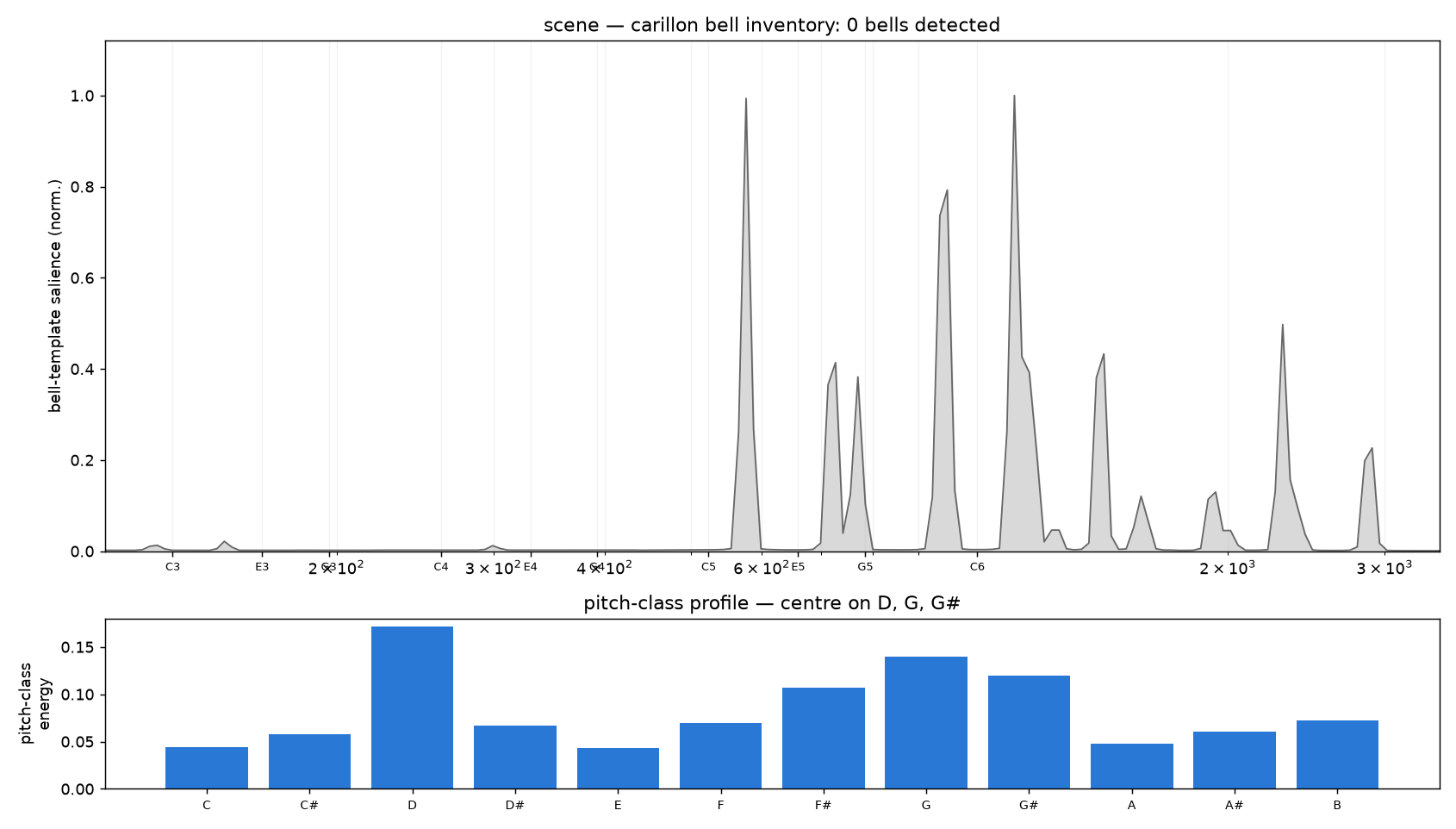
Writes carillon.json (detected bells with note names, frequencies and
cents, the range in use, and a folded chroma_profile) and carillon.png (the bell-salience
inventory with note labels, over a pitch-class profile).
Why naive pitch tracking fails
A struck bell is inharmonic. Its principal partials sit at fixed ratios to the strike note (the prime):
| partial | ratio | interval |
|---|---|---|
| hum | 1/2 | octave below |
| prime | 1 | the note |
| tierce | 6/5 | minor third above |
| quint | 3/2 | fifth above |
| nominal | 2 | octave above |
The loud tierce and nominal make a naive pitch tracker report notes a minor third
or an octave too high. Bell-template matching avoids the trap: for
every candidate strike note carillon sums the energy at all five partial positions, so
a true strike note—which has energy at all of them—outscores any single
partial. Accumulated over the onset frames of a whole recital, the peaks of that
salience are the bells that were played.
The minor-third tierce is the bell fingerprint: an octave-down "hum ghost" or a tierce/quint ghost of a real bell lacks its own tierce, so a genuine-tierce gate removes them cleanly (validated on synthetic bells in the test suite).
Caveats
- Distant / soft / masked bells are missed. Salience falls toward the noise floor in the treble; a bell struck rarely, or buried under the chord above it, may not clear the floor. The inventory is a lower bound on the instrument.
- Tuning cents are relative to A4 = 440 equal temperament. A consistent offset (e.g. a historic carillon tuned flat, or in meantone) shows as a systematic cents deviation across the detected bells.
- Runs on the W channel resampled to 22.05 kHz, in chunks, so an hour-long recital is fine.