Sound–motion entrainment
Does a body in the room move with the room's sound? ambiscape entrain
joins an analysed session with a body-motion accelerometer series on one
common clock and computes three entrainment measures, following the
crossmodal method of Guo, Riaz & Jensenius (CMMR 2025) — the AMBIENT
project's sound–motion join.
ambiscape entrain <session-folder> --motion motion.csv # needs a prior analyze run
--surrogates N sets the number of circular-shift surrogates per p-value
(default 200); -o picks the output directory.
There is no audio pass: the sound side comes from the cached 125 ms fast
level and per-second azimuth. Writes entrain.json and entrain.png
(aligned level/QoM timelines, an azimuth-vs-sway rose, and PLV by
modulation band with the surrogate significance floor), and folds
ent_-prefixed descriptors into an existing summary.json — the same
multimodal join as the vision module, so the corpus catalog
picks them up.
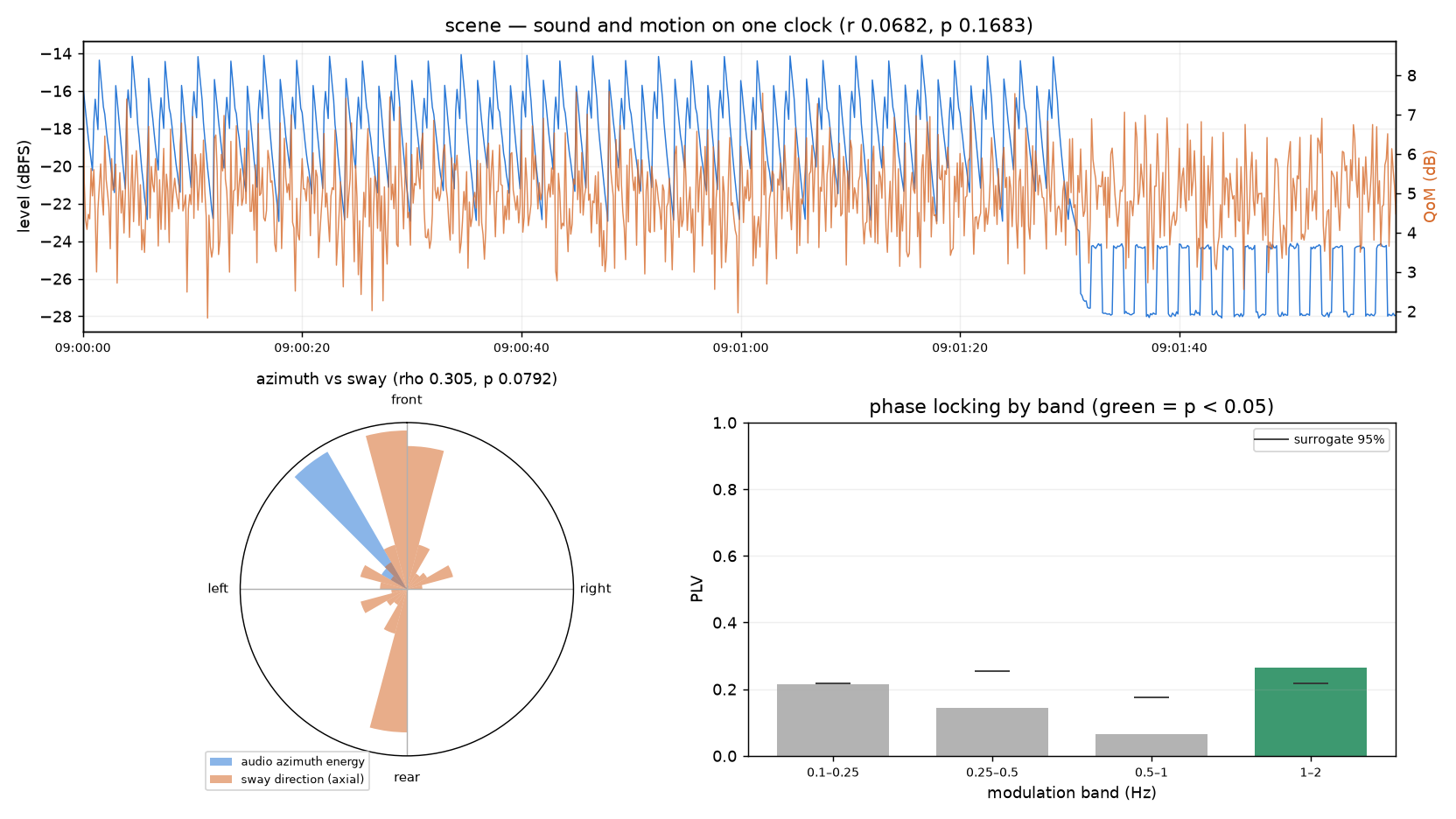
entrain.json holds four blocks — temporal, directional, plv, and
summary — plus a _method_note. The summary block is what lands in
summary.json: ent_overlap_min, ent_r_level_qom and ent_r_p,
ent_az_sway_rho and ent_az_sway_p, and ent_plv_max with
ent_plv_max_band_hz and ent_plv_max_p.
Motion input
A device-agnostic CSV/TSV: one timestamp column (ISO 8601 or plain
seconds) plus accelerometer x/y/z columns, in any consistent unit (g or
m/s²) — gravity is removed internally and every measure is scale-free, so
the unit never enters a result. Column names are matched loosely
(acc_x, ax, X (g) all work). ISO timestamps land on the session's
absolute clock (both devices are assumed set to the same local time; use
calibration.json clock offsets for a drifting recorder); a plain
seconds column that does not overlap the audio span is taken as relative
and aligned to the start of the audio.
Quantity of motion (QoM) is jerk magnitude after gravity removal (a 0.25 Hz low-pass), per Riaz's micromotion method, and the horizontal plane is defined by the gravity estimate itself — the sensor can sit at any orientation on the body.
The three measures
- Temporal correlation (
temporal_correlation): Pearson r between the 125 ms fast level (dB) and log-QoM. Significance comes from circular time-shift surrogates, not naive shuffling — shuffling would destroy the autocorrelation both series have and wildly overstate significance. - Directional correlation (
directional_correlation): the Jammalamadaka–SenGupta circular correlation between the audio's azimuth and the direction of horizontal micromotion (the per-frame principal axis, an axial quantity, angle-doubled before correlating). It is rotation-invariant, so the mic frame and the sensor frame need no alignment — but the sign of rho depends on frame handedness, so judge coupling by |rho| and p. Only frames above median energy in both streams enter the statistic. Requires directional audio (ambisonic, or stereo's lateral cue); skipped for mono. - Phase-locking value (
plv): per modulation band from 0.1 to 4 Hz, the Hilbert-phase locking between the audio's envelope modulation and the motion oscillation, each band with its own surrogate p-value and null 95th percentile. A caveat inherited from the surrogate logic: a strictly periodic pair (a metronome and a metronomic swayer) is indistinguishable from its own time-shifted surrogates, so PLV significance speaks to locking onto wandering real-world modulation, which is the conservative behaviour you want.
Rotation invariance is not reflection invariance
Mirroring one of the two angle series flips the coefficient's sign and leaves its magnitude exactly unchanged, so judging by |rho| places the blind spot precisely where a handedness error lands. A recorder mounted upside down writes Y inverted and its horizontal bearing becomes its own mirror image; no offset recovers that, and neither does a search over rotations, because a reflection is not in the set being searched. Such a search returns a poor best fit rather than a complaint. Settle handedness from how the rig was mounted, and from whether the recorder already compensated for it.
Whose frame is the azimuth in?
A recorder travelling on the same body as the sensor is partly measuring
that body's posture, and will correlate with its motion for reasons that
have nothing to do with the soundscape. Settle that first with
spatial.frame_reference_test;
a directional correlation from a body-referenced rig is not a fact about
the room.
A best-over-shifts figure is positive by construction
The circular shifts in this module are the null and never the answer. It is a short step to quoting the best-fitting shift's statistic instead, and that number rises with the number of shifts tried and with how smooth the two series are. On a year of daily recordings, the best of 72 circular shifts scored higher on deliberately mismatched day pairs than on real ones — 0.599 against 0.494 — after three separate hypotheses about the apparatus had been tested and none of them was the problem. If a maximum over alignments must be reported, run the same search over pairs known not to belong together and quote the difference.
In notebooks
import ambiscape as asc
from ambiscape import entrain

sess = asc.open_session("2026-07-15-Haarlem-loft")
J = entrain.join(sess, "motion.csv")        # common-clock series dict
doc = entrain.analyze_entrainment(sess, "motion.csv")
doc["summary"]                              # ent_* rows for summary.json
join returns the aligned series themselves (t, level_db, qom,
az_deg, sway_deg, sway_pow at 8 Hz) for custom analyses beyond the
three standard measures.