This week turns from the vocabulary from last week toward ways of describing what we listen to. Of the four levels of description, this chapter lives mostly at the level of interpretation. The same street can be measured, but a keynote, a signal, and a soundmark are categories about what a sound means to the people who live with it, not about its waveform.
Different sound analysis approaches
The three main directions in this course (musicology, psychology, and technology) describe sound in different ways, and each draws on its own subfields, with their own frameworks and vocabulary:
Acoustics focuses on the physical properties of sound waves, such as frequency, amplitude, duration, and propagation in different media. An acoustician might describe a clap in a concert hall as “a broadband impulse with a peak amplitude of 85 dB SPL, followed by a reverberation decay time of 1.8 seconds,” using measurements and graphs to show how sound behaves in the space.
Psychoacoustics investigates how humans perceive sound, using quantitative measures (frequency, loudness, spatial location) and perceptual attributes (brightness, roughness, etc.). A psychoacoustic study might report that “a 1000 Hz tone at 60 dB SPL is perceived as moderately loud and bright,” and compare listener responses to tones with varying roughness or spatial placement.
Music theory focuses on musical parameters (pitch, rhythm, timbre, dynamics) and cultural context. A musicologist might describe a violin tone as “a slightly sharp C, with a bright timbre, starting from pianissimo and with a gradual crescendo,” writing it out in musical notation.
Spectromorphology is a specialised form of music theory that analyses the spectral (frequency) and morphological (shape and evolution) characteristics of sounds. A spectromorphological analysis could describe a cymbal crash as “an impulsive onset followed by a complex, evolving spectrum that decays over several seconds,” visualised with a spectrogram showing frequency content over time.
All of these describe the sound “itself”. But different disciplines also bring in other factors.
Fields studying sound
Numerous fields study the effects of sound on people or environments:
Sound studies is an interdisciplinary field that examines sound as a cultural, social, and material phenomenon. It draws on media studies, anthropology, history, and philosophy to explore how sound shapes and is shaped by society, technology, and everyday life. A sound studies scholar might analyse how urban noise regulations reflect social attitudes toward public space, or investigate the role of sound in shaping collective memory and identity.
Acoustic ecology emphasises environmental context, categorising sounds as, for example, keynotes, signals, or soundmarks. Soundscapes are described in terms of their ecological function and impact. An acoustic ecologist could document a city park by noting “birdsong as a keynote, a distant siren as a signal, and the hourly chime of a church bell as a soundmark,” analysing how each sound shapes the experience of the space.
Ethnography is a subbranch of anthropology and uses qualitative methods such as interviews, field notes, and participatory observation to describe how communities interact with and interpret their sonic environments. An ethnographer might record that “residents describe the evening call to prayer as calming and unifying,” supplementing this with field notes and interviews about its social significance.
Linguistics and semiotics examine the meaning and communicative function of sounds, including onomatopoeia, prosody, and sound symbolism. A linguist could analyse the word “buzz” as onomatopoeic, noting how its sound mimics the noise of a bee, or study how rising intonation in speech signals a question.
There is no right or wrong when it comes to studying sound. All of these approaches (and more) aim to uncover various aspects of both the physical properties of sounds but also their meaning, context, and impact on listeners. Several of them are also used in multiple combinations. We will not have time to cover all of these in detail in this course, but we will look more closely at some of the closest ones to the fields of music psychology and technology. In particular, we will focus on two main concepts that have been influential in the development of our understanding of listening: soundscapes and sound objects.
Soundscapes
A soundscape is defined as the acoustic environment as people perceive and experience it, taking in all the sounds from natural and human-made sources alike. Describing a soundscape involves several dimensions:
- Physical properties: Documenting the types of sounds present (e.g., birdsong, traffic, water), their frequency ranges, loudness, and temporal patterns.
- Ecological function: Identifying the roles sounds play in the environment, such as signalling, masking, or providing information about ecological health.
- Spatial characteristics: Noting how sounds are distributed in space: directionality, distance, and reverberation within the environment.
- Perceptual attributes: Describing how listeners experience the soundscape: pleasantness, annoyance, tranquillity, or stimulation.
A soundscape description usually combines “objective” material, such as sound-level measurements and field recordings turned into spectrograms, with annotated sound maps and written notes. Read together, the measurements, the subjective impressions, and the context give a fuller picture of the sonic environment than any one of them could on its own.
R. Murray Schafer and acoustic ecology
R. Murray Schafer (1933–2021) was one of the pioneers of soundscape studies and the one who proposed the term soundscape for the acoustic environment as perceived by humans. From the 1960s he led the World Soundscape Project at Simon Fraser University in Canada, which studied, documented, and analysed the sonic environments of different places. Along the way, Schafer and his team developed new methods for field recording, sound mapping, and acoustic analysis, all aimed at understanding how sound shapes our experience of place and community.
Schafer’s best-known book is The Tuning of the World, later reissued as The Soundscape Schafer, 1994, which introduced several concepts for analysing soundscapes:
Keynote sounds are background sounds that are fundamental to a particular environment, often heard unconsciously. Examples include the hum of city traffic or the rustling of leaves in a forest. Keynotes set the acoustic context but are not usually the focus of attention.
Signals are foreground sounds that are listened to consciously because they carry specific information or meaning. Examples include a ringing phone, a siren, or a bird call. Signals stand out from the background and often prompt a response or action.
Soundmarks are unique or characteristic sounds that are especially valued by a community or location, similar to landmarks in the visual environment. Examples might be the chimes of a local church bell, a distinctive factory whistle, or a waterfall. Soundmarks help define a place’s identity and are often preserved or celebrated.
Schafer’s work founded the field of acoustic ecology and inspired similar projects worldwide, bringing together musicians, scientists, urban planners, and environmentalists. The World Soundscape Project argued for preserving valuable soundscapes and drew attention to the effects of noise pollution and urbanisation on the acoustic environment. It also led to the World Forum for Acoustic Ecology (WFAE), which gathers researchers, artists, educators, and practitioners around the relationship between people and their sonic environments.
These three categories were meant as tools for listening and description. A soundscape recording can be analysed for the steady background level that carries the keynote, for events that rise above it, and for the balance between natural, human, and mechanical sources. While such analyses were carried out manually in the past, nowadays, machine listening can analyse a soundscape with quite a level of detail.
Schafer also coined the term schizophonia for the separation of a sound from its source, usually through recording technology. When you hear a birdsong from a loudspeaker, the sound no longer comes from the bird but from a device. That split can change how we relate to a sound, sometimes making it feel less “authentic” or less connected to its original context.
Hildegard Westerkamp and soundwalking
Hildegard Westerkamp (1946–) worked with Schafer on the World Soundscape Project and is best known for developing soundwalking: walking through an environment while listening to it closely Westerkamp, 2007. It is as much a way of paying attention as a technique. A soundwalk makes you aware of the acoustic ecology around you, and it has been used for artistic inspiration, environmental awareness, and even therapy.
Key aspects of soundwalking include:
- Active listening: Paying close attention to the layers of sound in the environment, from the most prominent to the subtle.
- Contextual awareness: Understanding how sounds interact with the physical and social context of a space.
- Documentation: Participants may choose to record sounds, take notes, or create maps to capture their auditory experience, keeping in mind that recording an inhabited place also records the people in it (see Recording people, not only places below).
Westerkamp used soundwalking in both research and art. In her research, soundwalks gathered data on urban and natural soundscapes. Participants documented what they heard, which helped researchers analyse acoustic environments, locate sources of noise pollution, and understand how people perceive their surroundings. This work fed into acoustic ecology, urban planning, and environmental psychology.
As an artist, she turned soundwalking into a way of composing. Pieces such as Kits Beach Soundwalk build on field recordings and reflections gathered while walking, often weaving environmental sound together with narration so that listeners experience a place through attentive listening.
Westerkamp’s idea of “music-as-environment” treats everyday acoustic surroundings as musical material in their own right, since a city, a shoreline, or a forest can be heard as a dynamic, layered sounding rather than a backdrop. Soundwalking trains a sustained, analytical kind of listening that brings out relationships, textures, and patterns over time. In doing so it blurs the roles of composer, performer, and audience, and suggests that careful attention to environmental sound can be both an artistic and a communal practice.
Steven Feld and acoustemology
Steven Feld (1949–) is an ethnomusicologist known for his pioneering work on the relationship between sound, culture, and perception. Feld introduced the concept of acoustemology—a blend of “acoustics” and “epistemology”—to describe how knowledge and experience are shaped through sound and listening.
Acoustemology emphasises that listening is not just a sensory act but a way of knowing and engaging with the world. Feld’s research with the Kaluli people of Papua New Guinea, presented in his book Sound and Sentiment Feld, 2012, demonstrated how sound is deeply embedded in social life, memory, and identity. He explored how environmental sounds, music, and language are interconnected, and how communities use sound to make sense of their surroundings.
Key aspects of acoustemology include understanding sound as a primary medium for learning, communication, and relating to place. Feld argues that listening practices are shaped by cultural context, history, and environment, and communities define themselves and their spaces through distinctive soundscapes and musical traditions. His work encourages researchers and listeners to consider how sound shapes experience and meaning, and to use listening as a method for understanding both local and global cultures.
Development, enculturation, and listening expertise
Listening is shaped by lifetime exposure and cultural context. Developmental research shows how infants gradually tune in to speech and musical pitch patterns in their environment; enculturation explains why rhythms and tonal hierarchies that sound “natural” in one tradition can sound ambiguous or surprising to listeners versed in another.
This matters in three practical ways:
- Expertise — Training shifts attention, since performers often hear layerings and errors differently from novice listeners.
- Expectation — Statistical regularities in the music you know generate predictions; surprise often carries expressive meaning.
- Ethics of comparison — Avoid judging unfamiliar repertoires solely through Western tonal terminology; describe sound first, then relate analytic tools explicitly to the tradition.
You need not absorb developmental psychology in depth here; keep the idea that listening competencies are learned, culture-specific, and measurable, which bridges listening practices with later chapters on physiology and neuroscience. The next section turns from how listening develops to where most of it actually happens.
Everyday listening and musical preference
The traditions above treat listening as a deliberate, attentive practice. Most listening in daily life is not like that. Music accompanies commuting, studying, training, cooking, and falling asleep, and it is often chosen for what it does rather than for what it is. Researchers call this everyday or functional listening. The British music psychologists Adrian North and David Hargreaves have mapped these uses systematically, showing that people reach for music to regulate mood and energy, to pass time, to create privacy in public spaces, and to signal identity to themselves and others North & Hargreaves, 2008. John Sloboda and colleagues asked people to log every musical episode in their day and found that music was rarely the main activity; it almost always ran alongside something else Juslin & Sloboda, 2010.
Streaming has industrialised this functional listening. Playlists named after activities and moods, such as “Deep Focus”, “Beast Mode”, or “Sad Hour”, curate music by what it should do to you, and recommendation algorithms learn your habits and serve more of the same. Where a record collection once expressed taste, a streaming profile increasingly expresses routine. When a playlist manages your mood, who is doing the listening? Partly you, and partly a system trained on millions of other listeners, a theme that returns in machine listening.
Attention also varies through the day. Sometimes the ears are open: a new song catches your attention, and you look up who made it. More often playlist listening turns the stream of songs into “sonic wallpaper” while you write an essay. Neither mode is wrong. The distinction between hearing and listening from last week is not a wall but a dial that turns many times a day.
Preferences differ between individuals as well as situations. Age is the strongest factor. The music people meet in their teens and early twenties keeps a privileged place in memory and preference for the rest of life, a phenomenon known as the reminiscence bump. Personality plays a smaller part, with the trait openness to experience linked to a taste for complex and unfamiliar styles, and extraversion to energetic, rhythmic music, although the correlations are modest North & Hargreaves, 2008. Sheer repeated exposure also breeds liking, up to a point Margulis, 2018.
Concert listening
Why do audiences sit still and silent at a classical concert? It may feel like the natural way to listen to music, but it is a fairly recent habit. Eighteenth-century audiences in Paris and London talked, ate, moved about, and applauded in the middle of a piece when they liked a passage. In 1778, Mozart wrote to his father that the Paris audience had burst into applause in the middle of the first movement of his Symphony no. 31, at a passage he had written to please them. During the 19th century, as music came to be heard as art to be contemplated, silence and stillness became the norm in the concert hall Johnson, 1995. Many other musical settings, from jazz clubs to raves, kept the moving audience.
Sound objects
After considering soundscapes more broadly, let us “zoom in” to investigate specific sonic events in more detail. While soundscape studies developed in Canada in the 1970s and beyond, they were greatly inspired by the French “school” of composers and theorists working in Paris in the 1950s.
Pierre Schaeffer and the sound object
The concept of sound object—l’objet sonore in French—was proposed by the French composer and musicologist Pierre Schaeffer (1910–1995). He argued that we do not hear sound as one continuous stream; instead, perception groups it into separate sound objects, each with its own properties. In speech we hear words rather than single phonemes; in music we hear tones and short phrases that fuse into “chunks” of sound, typically lasting 0.5 to 5 seconds Godøy et al., 2010. Schaeffer sorted these objects into three core types:
- Impulsive: Short, percussive sounds (e.g., a click or a drum hit).
- Sustained: Continuous sounds with steady qualities (e.g., a drone or a held note).
- Iterative: Rapidly repeating sounds (e.g., a tremolo or a rattling noise).
These categories belong to a larger spectromorphology that can describe any kind of sound. The boundaries are not always sharp. A drum roll played slowly is heard as separate impulsive sounds; played fast, the hits fuse into one iterative sound, and very fast it comes close to a sustained sound. It often helps to think of the action behind the sound: a single burst of energy gives an impulsive sound, a continuous supply of energy (bowing, blowing) gives a sustained sound, and a rapid series of bursts gives an iterative sound.
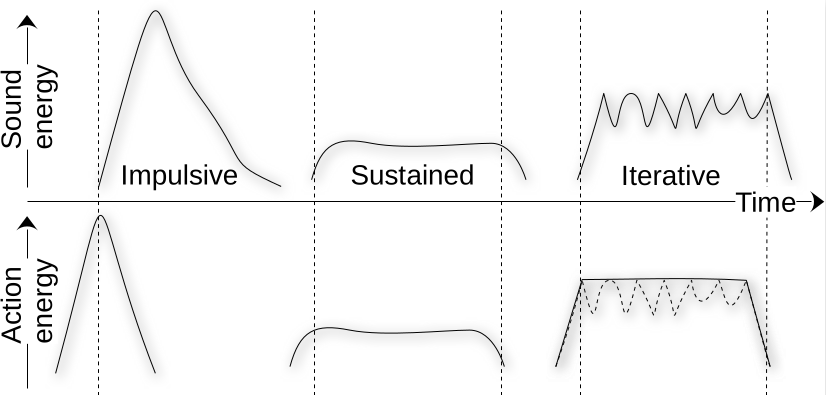
An illustration of Schaeffer’s three sound types, from Jensenius (2022).
Schaeffer worked as both composer and researcher. His method combined careful listening, detailed description, and hands-on manipulation of recorded sound. This was done by cutting and splicing tapes, changing speeds, and looping fragments to turn found sounds into musical structures. Like Varèse, he put timbre, texture, and temporal form ahead of traditional notation.
This way of treating recorded environmental and instrumental sounds as compositional was called musique concrète and can be seen as the beginning of the broader field of electroacoustic music. From its early beginnings in the 1940s, it has grown into a practice that uses electronic technology for generating, processing, and spatialising sound, from tape pieces and live electronics to computer music and immersive multi-channel installations.
Schaeffer’s practice of “reduced listening” also gave rise to acousmatic listening: listening to sounds cut off from their visible causes. Acousmatic concerts, often presented over loudspeaker arrays and sometimes in darkness, focus attention on the perceptual and morphological qualities of sound: spectral content, envelope, and movement.
Expanding Schaeffer’s thinking
Schaeffer’s taxonomy of sound objects and his listening exercises still inform analysis, sound design, auditory cognition research, and teaching, and techniques such as tape montage and close spectromorphological listening remain in use today.
Several theorists have built on Pierre Schaeffer’s ideas about sound objects and listening:
Dennis Smalley (1946–, University of London) formalised the concept of spectromorphology, giving analysts a detailed vocabulary for the spectral and morphological evolution of sounds. His approach is widely used in electroacoustic music analysis and clarifies how listeners perceive the shape and transformation of sound objects over time.
Lasse Thoresen (1949–, Norwegian Academy of Music) has extended spectromorphological analysis into practical frameworks for describing and notating sound objects in both electroacoustic and acoustic music, making Schaeffer’s taxonomy usable for composers and analysts.
Rolf Inge Godøy (1955–, University of Oslo) has developed detailed models of how listeners perceive and mentally represent sound objects. His notion of gestural-sonorous objects ties sound perception to physical gesture and movement, and connects to embodied music cognition.
Michel Chion (1947–) introduced synchresis in his book Audio-Vision Chion, 2019: the way a sound and a visual event are perceived as belonging together even when they have been synchronised artificially. The idea is central to audiovisual theory and to film sound design (the field keeps its own term; by the levels used in this course it would be auditory–visual, since it names perception rather than files), where pairing a sound with an on-screen action welds the two together and strengthens a scene’s emotional and narrative impact, whatever the sound’s real source.
Artistic explorations
As the overview above shows, the development of soundscapes and sound object theory has been driven by researchers who identify as both artists and scientists, producing both artistic and scientific results. This may be uncommon in some fields, but in sound and music, theoretical development can be seen as emerging from creative practice, and artistic practice has been inspired by theoretical development. Here, we will look at some influential artworks that have been part of the same development.
John Cage and 4’33’’
John Cage (1912–1992) was an American composer and music theorist whose work challenged traditional notions of sound and music. One of his most influential and controversial pieces is 4’33’', composed in 1952. The piece consists of three movements, during which the performer is instructed not to play their instrument. Instead, the focus shifts to the ambient sounds of the environment, making the audience’s listening experience the central element of the composition. Cage’s work explores the idea that silence is never truly silent. The piece invites listeners to listen to the sounds around them, blurring the line between music and environmental noise. This is the aesthetic side of the point made in the acoustics chapter: no sound is noise by nature, and what is noise to one listener can be music to another. 4’33’’ is a seminal work in experimental music, influencing fields such as sound art, acoustic ecology, and contemporary composition. The video below shows the pianist William Marx performing the piece:
Pauline Oliveros and Deep Listening
Pauline Oliveros (1932–2016) created the Deep Listening practice, described in her book of the same name Oliveros, 2005, emphasising sonic awareness as heightened attention to sound and its context. Her Sonic Meditations is a collection of text-based instructions (1971) guiding groups in listening and sound-making exercises, fostering communal awareness and creativity. Bye Bye Butterfly (1965) was an early electronic composition blending live feedback and tape delay, reflecting on the transformation of sound and memory.
Throughout her long career, Oliveros made numerous performances exploring acoustic space and group interaction. Oliveros’s work encourages active, inclusive listening and has influenced contemporary sound art, music therapy, and community music practices. In her TEDx talk The difference between hearing and listening, Oliveros explains this approach in her own words:
Yoko Ono and experimental listening
Yoko Ono (1933–) is an artist and composer whose work often challenges the boundaries between sound, performance, and audience participation. Her Instruction Pieces, such as those in Grapefruit (1964), invite listeners and performers to engage with sound and silence in imaginative, conceptual ways. Ono treats listening itself as a creative act, asking audiences to hear everyday sounds as art and to reflect on the relationship between sound, environment, and intention.
Alvin Lucier and “I am sitting in a room”
Alvin Lucier (1931–2021) was an American composer known for his experimental works exploring acoustic phenomena and the perception of sound. His iconic piece, I am sitting in a room (1969), is a landmark in sound art and acoustic ecology. In this work, Lucier records himself reading a text describing the process. He is sitting in a room, recording his voice, and repeatedly plays back and rerecords the tape. With each iteration, the room’s resonant frequencies reinforce themselves, gradually transforming the speech into pure tones shaped by the space’s acoustics. Eventually, the words become unintelligible, replaced by the sonic “fingerprint” of the room.
Norwegian artists and practitioners
Norway has a vibrant community of artists and researchers working with soundscapes, listening practices, acoustic ecology, and electroacoustic composition, including:
- Britt Pernille Frøholm (1974–): Composer and performer exploring acoustic ecology and soundscape composition in Norwegian landscapes.
- Espen Sommer Eide (1972–): Artist and musician working with field recordings, sound installations, and listening walks.
- Jana Winderen (1965–): Sound artist whose field recordings and installations focus on underwater and natural sound environments.
- Maja S. K. Ratkje (1973–): Composer and performer integrating environmental sounds and experimental listening in her works.
- Natasha Barrett (1972–): Composer and sound artist specialising in spatial audio, immersive sound installations, and electroacoustic composition.
These practitioners have contributed to both artistic and academic developments in the field, often collaborating across disciplines to deepen our understanding of sound and listening in Norwegian contexts.
Capturing sound
Let us conclude this week by summarising how we can capture and represent sound. This can include written descriptions, visual representations, and audio recordings.
Writing about sound
Writing about sound is a way to translate auditory experiences into language. It is always good to start with some contextual notes, such as recording the time, location, and circumstances in which the sound occurred. Then you can capture your emotional or sensory response to the sound, noting how it affected your mood or perception.
A more analytical approach involves breaking the sound down into components and discussing its structure or function. A simple starting point is to describe six sonic attributes, such as the ones listed in this sound education material:
| Attribute | Description | Range/Examples |
|---|---|---|
| Duration | Length of sound | Short – Long |
| Intensity | Loudness | Soft – Loud |
| Pitch | Frequency | Low – High |
| Timbre | Sound quality | Pure – Noisy |
| Pattern | Repetition/Order | Regular – Irregular |
| Speed | Tempo | Slow – Fast |
Each attribute returns later in the book with a precise meaning: intensity becomes amplitude and decibels in the acoustics chapter, pitch and timbre are unpacked in psychoacoustics, and pattern and speed become rhythm and tempo in time and rhythm. For now, plain words are enough. Note also the division of labour between the vocabularies in this chapter: the six attributes describe individual sounds, while Schafer’s keynote sounds, sound signals, and soundmarks describe the soundscape they together form. Smalley’s spectromorphology offers a further system for professional analysis, but it is not needed for the exercises in this course.
Drawing sounds
Words may not always be the best way to represent sounds you hear. Sometimes, drawing sounds can be more efficient. People use different approaches; some draw timelines with “waveforms” that represent the amplitude and shape of a sound over time. Others use shapes, lines, and colours to depict qualities such as loudness, pitch, or texture.
During soundwalking, it may help to create maps or diagrams showing the spatial distribution of sounds in an environment. Such visual representations can reveal patterns and relationships that are difficult to express in words and are helpful in both artistic and scientific contexts.
Recording sounds
Recording sounds is the most direct and “objective” way to capture and preserve sonic events. However, it is important to remember that recordings are not objective at all. There are numerous ways to record sounds. Your location matters a lot. The choice of microphone also highly influences the recorded audio. We will talk more about microphones in electroacoustics, but remember that the best sound recorder is the one you have at hand and use. In many cases, a mobile phone can do the job, particularly if you set it to record with high quality.
While single-microphone recordings are fine for capturing sound objects, stereo or ambisonics recorders are more popular for capturing soundscapes. The latter captures the whole soundfield so that it can be recreated in “surround”.
Regardless of the devices used, pay attention to microphone placement, level settings, and background noise to ensure clear recordings. It also helps to keep notes about the recording context, including date, time, location, and any relevant observations. That makes it easier to organise recordings for future use and for sharing with others.
Visualising a soundscape
Schafer’s keynote / signal / soundmark distinction maps neatly onto a spectrogram. Below we build a short synthetic soundscape—a low traffic-like rumble (keynote), a few bird chirps (signals), and a single bell (a soundmark)—and look at it as both sound and image.
Source
import numpy as np
from scipy.signal import spectrogram
from IPython.display import Audio, display
import matplotlib.pyplot as plt
plt.rcParams.update({
    "font.size": 10,
    "axes.titlesize": 11,
    "axes.labelsize": 10,
    "xtick.labelsize": 9,
    "ytick.labelsize": 9,
    "legend.fontsize": 9,
    "figure.figsize": (10, 4),
    "figure.dpi": 100,
    "savefig.dpi": 150,
    "axes.spines.top": False,
    "axes.spines.right": False,
})

sr = 22050
dur = 6.0
t = np.linspace(0, dur, int(sr * dur), endpoint=False)
rng = np.random.default_rng(0)

# Keynote: low-frequency traffic-like rumble
spec = np.fft.rfft(rng.standard_normal(len(t)))
freqs = np.fft.rfftfreq(len(t), 1 / sr)
spec[freqs > 400] = 0
rumble = np.fft.irfft(spec, n=len(t))
soundscape = 0.3 * rumble / np.max(np.abs(rumble))

# Signals: short rising bird chirps at random times
for _ in range(8):
    onset = rng.uniform(0, dur - 0.3)
    tt = np.linspace(0, 0.2, int(sr * 0.2), endpoint=False)
    chirp = 0.3 * np.sin(2 * np.pi * (rng.uniform(2500, 3500) + 3000 * tt) * tt) * np.hanning(len(tt))
    i = int(onset * sr)
    soundscape[i:i + len(chirp)] += chirp

# Soundmark: a bell at 3 s
tt = np.linspace(0, 1.5, int(sr * 1.5), endpoint=False)
bell = 0.3 * (np.sin(2 * np.pi * 880 * tt) + 0.5 * np.sin(2 * np.pi * 2429 * tt)) * np.exp(-tt / 0.6)
i = int(3.0 * sr)
soundscape[i:i + len(bell)] += bell

soundscape *= 0.5 / np.max(np.abs(soundscape))
display(Audio(soundscape, rate=sr))

f, tt2, Sxx = spectrogram(soundscape, fs=sr, nperseg=1024)
fig, ax = plt.subplots(figsize=(10, 3))
ax.pcolormesh(tt2, f, 10 * np.log10(Sxx + 1e-12), shading="auto")
ax.set_ylim(0, 5000)
ax.set_xlabel("Time (s)")
ax.set_ylabel("Frequency (Hz)")
ax.set_title("Spectrogram of a synthetic soundscape: rumble (keynote), birds (signals), bell (soundmark)")
plt.tight_layout()
plt.show()
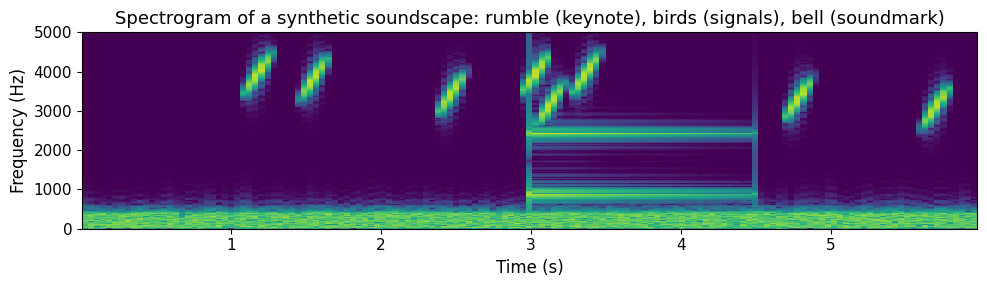
We will work more with spectrograms in the coming weeks.
A critical look: are natural soundscapes restorative?
Playlists of birdsong and rain promise focus, calm, and sleep. Behind the marketing sits a real research tradition, and it is worth separating what it shows from what it does not.
- The claim is that natural soundscapes restore attention and speed up recovery from stress, an idea rooted in attention restoration theory Kaplan, 1995.
- The evidence includes laboratory studies such as Alvarsson et al. (2010), where skin conductance showed participants recovering from a stressful task faster while hearing birds and a fountain than while hearing traffic noise. A narrative review of the field finds broadly positive but mixed results Ratcliffe, 2021.
- The method is typically a short recorded clip played through headphones to a few dozen people in a laboratory, with mood ratings or physiological measures taken before and after.
- The limits follow from that method. A one-minute clip of a fountain is not a forest, so laboratory findings may not transfer to real places. Field studies face self-selection, since people who seek out quiet green places differ from those who do not. And pleasantness and familiarity, rather than naturalness itself, may be doing the restoring.
- A local field study took the question indoors. When artificial birdsong was played from motion-triggered loudspeakers in shared spaces at the University of Oslo, people reported feeling calmer and better able to focus, but the effect depended on the birdsong seeming plausible in its setting, and people wanted control over it Riaz et al., 2025.
Restorative claims about soundscapes are plausible and partly supported, but they are claims about perception and interpretation, not about the sounds themselves. That is worth remembering the next time an app promises that rain will make you concentrate.
- Schafer, R. M. (1994). The Soundscape: Our Sonic Environment and the Tuning of the World. Destiny Books.
- Westerkamp, H. (2007). Soundwalking. In A. Carlyle (Ed.), Autumn Leaves: Sound and the Environment in Artistic Practice (pp. 49–54). Double Entendre.
- Feld, S. (2012). Sound and Sentiment: Birds, Weeping, Poetics, and Song in Kaluli Expression (3rd ed.). Duke University Press. 10.1215/9780822395898
- North, A. C., & Hargreaves, D. J. (2008). The Social and Applied Psychology of Music. Oxford University Press. 10.1093/acprof:oso/9780198567424.001.0001
- Juslin, P. N., & Sloboda, J. A. (Eds.). (2010). Handbook of Music and Emotion: Theory, Research, Applications. Oxford University Press. 10.1093/acprof:oso/9780199230143.001.0001
- Margulis, E. H. (2018). The Psychology of Music: A Very Short Introduction. Oxford University Press. 10.1093/actrade/9780190640156.001.0001
- Johnson, J. H. (1995). Listening in Paris: A Cultural History. University of California Press.
- Godøy, R. I., Jensenius, A. R., & Nymoen, K. (2010). Chunking in Music by Coarticulation. Acta Acustica United with Acustica, 96(4), 690–700. 10.3813/AAA.918323
- Jensenius, A. R. (2022). Sound Actions: Conceptualizing Musical Instruments. The MIT Press. 10.7551/mitpress/14220.001.0001
- Chion, M. (2019). Audio-Vision: Sound on Screen (2nd ed.). Columbia University Press. 10.7312/chio18588
- Oliveros, P. (2005). Deep Listening: A Composer’s Sound Practice. iUniverse.
- Kaplan, S. (1995). The Restorative Benefits of Nature: Toward an Integrative Framework. Journal of Environmental Psychology, 15(3), 169–182. 10.1016/0272-4944(95)90001-2
- Alvarsson, J. J., Wiens, S., & Nilsson, M. E. (2010). Stress Recovery during Exposure to Nature Sound and Environmental Noise. International Journal of Environmental Research and Public Health, 7(3), 1036–1046. 10.3390/ijerph7031036
- Ratcliffe, E. (2021). Sound and Soundscape in Restorative Natural Environments: A Narrative Literature Review. Frontiers in Psychology, 12, 570563. 10.3389/fpsyg.2021.570563
- Riaz, M., Guo, J., Serdar Göksülük, B., & Jensenius, A. R. (2025). Where is That Bird? The Impact of Artificial Birdsong in Public Indoor Environments. Proceedings of the 20th International Audio Mostly Conference, 344–351. 10.1145/3771594.3771629