This chapter works at the culture layer of the five layers. It arrives in week 3 rather than at the end of the semester because every chapter after it needs its vocabulary. You cannot talk honestly about image models in week 5 without a way of talking about training data, and you cannot talk about voice cloning in week 6 without a way of talking about consent. The chapter therefore builds the vocabulary now, and the nine weeks after it put the vocabulary to work.
The chapter has two halves that are usually kept apart, and that this book deliberately keeps together. The first half asks how do you work with this thing: what kind of collaborator a generative model is, and what tensions you should expect to manage rather than solve. The second half asks at whose cost: where the material for that collaboration came from, who was paid, who was not, and what your own practice owes them.
Both halves land in the same place. The more clearly you can describe your own role in a piece of work, the more clearly you can describe what you owe the people whose work made yours possible.
Executors and collaborators
Chapter 2 ended with a list of things generative models cannot do. Read that list again and notice that it is not a list of bugs awaiting a patch. It is a description of a collaborator with a strange and specific set of blind spots, which means that working well with one is closer to a management problem than a tool-use problem.
Salma, Hijón-Neira, and Pizarro give the most useful handle on that problem Salma et al., 2025. Their argument is that the generative tools in wide use through 2025 almost all behave as executors: you issue a command, they produce an output, and the transaction is complete. Creative work is not like that. It is non-linear, iterative, and ambiguous, and it usually does not know what it wants until it sees what it does not want.
Source
from matplotlib.patches import FancyBboxPatch

import matplotlib.pyplot as plt
plt.rcParams.update({
    "font.size": 10,
    "axes.titlesize": 11,
    "axes.labelsize": 10,
    "xtick.labelsize": 9,
    "ytick.labelsize": 9,
    "legend.fontsize": 9,
    "figure.figsize": (10, 4),
    "figure.dpi": 100,
    "savefig.dpi": 150,
    "axes.spines.top": False,
    "axes.spines.right": False,
})

navy, purple, rose = "#1f2545", "#5a2a7a", "#e8556d"

fig, ax = plt.subplots(figsize=(10, 4.6))


def box(x, y, w, h, title, subtitle=None, outcome=False):
    ax.add_patch(FancyBboxPatch((x, y), w, h,
                                boxstyle="round,pad=0.02,rounding_size=0.15",
                                facecolor="#fff0f3" if outcome else "#f4f1fa",
                                edgecolor=rose if outcome else purple, linewidth=1.8))
    ax.text(x + w / 2, y + h / 2 + (0.14 if subtitle else 0), title, ha="center",
            va="center", fontsize=11, color=navy)
    if subtitle:
        ax.text(x + w / 2, y + h / 2 - 0.2, subtitle, ha="center", va="center",
                fontsize=10, color="#444444")


ax.text(0.4, 5.55, "The executor: one command, one output, transaction complete",
        fontsize=11, fontweight="bold", color=purple)
box(0.4, 4.3, 2.4, 0.9, "Command")
box(4.0, 4.3, 2.4, 0.9, "Model")
box(7.6, 4.3, 2.4, 0.9, "Output", outcome=True)
for x1, x2 in [(2.8, 4.0), (6.4, 7.6)]:
    ax.annotate("", xy=(x2, 4.75), xytext=(x1, 4.75),
                arrowprops=dict(arrowstyle="-|>", color=navy, lw=1.8))

ax.plot([0.4, 11.6], [3.9, 3.9], color="#cfc7dd", lw=1)

ax.text(0.4, 3.4, "The collaborator: a loop the person keeps steering",
        fontsize=11, fontweight="bold", color=purple)
box(0.4, 2.1, 2.2, 0.95, "Brief")
box(3.2, 2.1, 2.2, 0.95, "Variations", "at least three")
box(6.0, 2.1, 2.2, 0.95, "Selection", "and veto")
box(8.8, 2.1, 2.2, 0.95, "Edit", "and context", outcome=True)
for x1, x2 in [(2.6, 3.2), (5.4, 6.0), (8.2, 8.8)]:
    ax.annotate("", xy=(x2, 2.575), xytext=(x1, 2.575),
                arrowprops=dict(arrowstyle="-|>", color=navy, lw=1.8))

ax.plot([9.9, 9.9, 1.5, 1.5], [2.1, 1.4, 1.4, 2.1], color=rose, lw=1.8, ls="--")
ax.annotate("", xy=(1.5, 2.1), xytext=(1.5, 1.4),
            arrowprops=dict(arrowstyle="-|>", color=rose, lw=1.8))
ax.text(5.7, 1.05, "what the output revealed goes back into the brief",
        ha="center", fontsize=10, color=rose)

ax.set_xlim(0, 12)
ax.set_ylim(0.6, 6.0)
ax.axis("off")
plt.tight_layout()
plt.show()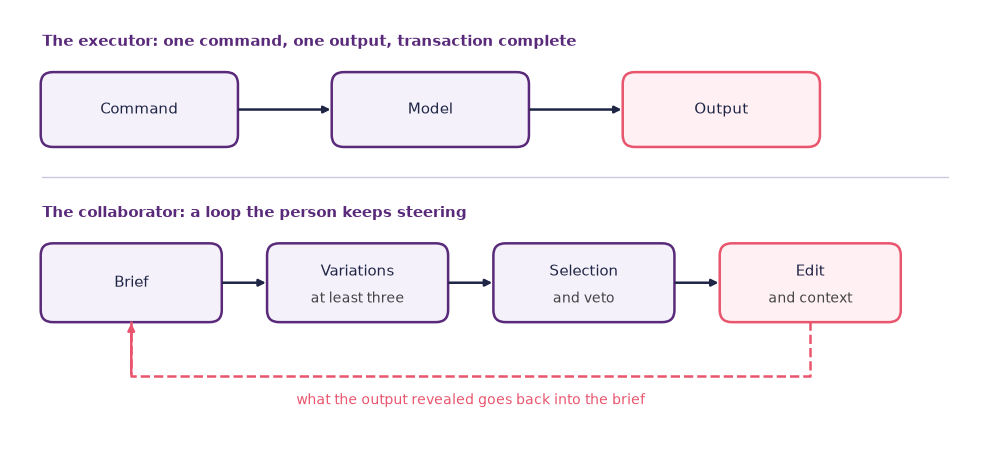
Figure: An executor takes a command, returns an output, and the transaction ends there. A collaborator is a loop in which a brief leads to variations, a selection, and an edit, and what the output revealed goes back into the brief.
That mismatch between an executor and a creative process produces five tensions that Salma and colleagues call paradoxes, because they cannot be designed away.
| Paradox | Core tension | Practical question for you |
|---|---|---|
| Ambiguity versus precision | Your creative intent is vague; the model needs precise input. | How do you translate a vision into a prompt without prematurely closing the exploration? |
| Control versus serendipity | You want to steer; the most interesting outputs are the unexpected ones. | How do you stay open to happy accidents while keeping authorship? |
| Speed versus reflection | The model generates in seconds; understanding takes minutes. | Where will you build in pauses, friction, and re-reading? |
| Individual versus collective | Your voice is particular; the model is trained on the average of millions of voices. | How do you keep your signature when your collaborator is the wisdom of the crowd? |
| Originality versus remix | Generative AI is an extreme remix engine; you also want work that is yours. | Where does the novelty come from: the model, the prompt, the edits, or the curation? |
A good Creative AI practice does not try to resolve these tensions, but learns to live inside them, leaning to one side when the project needs it and to the other when it needs the opposite.
Here is what that looks like in practice, one paradox at a time.
Ambiguity versus precision. A useful early move is to over-describe in plain language, something like “I want this to feel like an early-morning Oslo trikk (the tram) window seen from a damp coat”. Then ask the model to translate your description into a prompt it can actually work with. You keep the ambiguity in your head; the model converts it to precision on the canvas. What you want is a multi-turn refinement loop, not a single large input box.
Control versus serendipity. Generate at least three variations of anything you care about. The one you would not have chosen on paper is often the one that does the most work for you. Veto power over suggestions is your most important skill in this mode, and a veto includes the productive move of saying “this is wrong, but the wrongness gives me an idea”.
Speed versus reflection. A model can produce a finished-sounding song in ninety seconds. Spend at least ten minutes listening to it before you ask for the next one. Build pause points into your workflow deliberately, because the standing risk of generative AI in education and in professional practice is attentional deskilling: losing the habit of looking at something for a long time.
Individual versus collective. Watch for the pull towards the average. If every image of a Norwegian fjord the model gives you looks like the same tourism poster, you are getting the collective. Your work then needs an explicit push the other way: a reference image, a style constraint, a stranger subject, or an act of refusal.
Originality versus remix. Accept, honestly, that the model is recombining prior work. Your originality lives in the brief, the prompt, the selection, the edits, and the context you put around the output. That is also where this chapter’s second half begins, because in a culture saturated with remix the centre of gravity of authorship shifts from making towards directing and curating, and directing carries obligations that pressing “generate” does not.
These five paradoxes quietly structure the rest of the book. Every applied chapter, on language, images, sound, video, spatial media, code, and agents, runs the same five tensions in a different medium. By the end of the semester you should be able to name which paradox you are wrestling with in any lab session, and a good Surprise and Will process memo is usually a story about exactly one of them.
A simple ethical frame
The rest of the chapter needs a frame. For any Creative AI system, four questions get you most of the way to a defensible position.
- Who benefits? Users, the company, particular groups, society at large?
- Who is harmed, or could be? Workers whose material is in the training data, users, bystanders, the planet?
- Is the benefit proportional to the harm?
- Are the harms consented to by the people bearing them?
You will meet versions of these four questions in every serious AI ethics framework, from the Belmont Report of 1979 through UNESCO’s Recommendation on the Ethics of Artificial Intelligence UNESCO, 2022 to the EU AI Act European Parliament,Council of the European Union, 2024.
Source
from matplotlib.patches import FancyBboxPatch

import matplotlib.pyplot as plt
plt.rcParams.update({
    "font.size": 10,
    "axes.titlesize": 11,
    "axes.labelsize": 10,
    "xtick.labelsize": 9,
    "ytick.labelsize": 9,
    "legend.fontsize": 9,
    "figure.figsize": (10, 4),
    "figure.dpi": 100,
    "savefig.dpi": 150,
    "axes.spines.top": False,
    "axes.spines.right": False,
})

navy, purple, rose = "#1f2545", "#5a2a7a", "#e8556d"
questions = [
    (0.4, 4.3, "1", "Who benefits?", "users, company, society", False),
    (8.2, 4.3, "2", "Who is harmed?", "workers, bystanders, planet", False),
    (0.4, 0.6, "3", "Is it proportional?", "benefit weighed against harm", False),
    (8.2, 0.6, "4", "Was it consented to?", "by those bearing the harm", True),
]

fig, ax = plt.subplots(figsize=(10, 4.6))
ax.add_patch(FancyBboxPatch((4.4, 2.3), 3.2, 1.2,
                            boxstyle="round,pad=0.02,rounding_size=0.18",
                            facecolor=purple, edgecolor=purple, linewidth=2))
ax.text(6.0, 2.9, "One system,\none use", ha="center", va="center",
        fontsize=11, fontweight="bold", color="white")

for x, y, number, question, gloss, outcome in questions:
    ax.add_patch(FancyBboxPatch((x, y), 3.4, 1.1,
                                boxstyle="round,pad=0.02,rounding_size=0.15",
                                facecolor="#fff0f3" if outcome else "#f4f1fa",
                                edgecolor=rose if outcome else purple, linewidth=1.8))
    ax.text(x + 0.25, y + 0.78, number, fontsize=11, fontweight="bold", color=purple)
    ax.text(x + 1.7, y + 0.75, question, ha="center", fontsize=11, color=navy)
    ax.text(x + 1.7, y + 0.35, gloss, ha="center", fontsize=10, color="#444444")
    start = (x + 3.4, y + 0.4) if x < 4 else (x, y + 0.4)
    end = (4.3, 3.2) if x < 4 else (7.7, 3.2)
    if y < 2:
        start = (start[0], y + 0.7)
        end = (end[0], 2.6)
    ax.annotate("", xy=end, xytext=start,
                arrowprops=dict(arrowstyle="-|>", color=navy, lw=1.8))

ax.set_xlim(0, 12)
ax.set_ylim(0.3, 5.7)
ax.axis("off")
plt.tight_layout()
plt.show()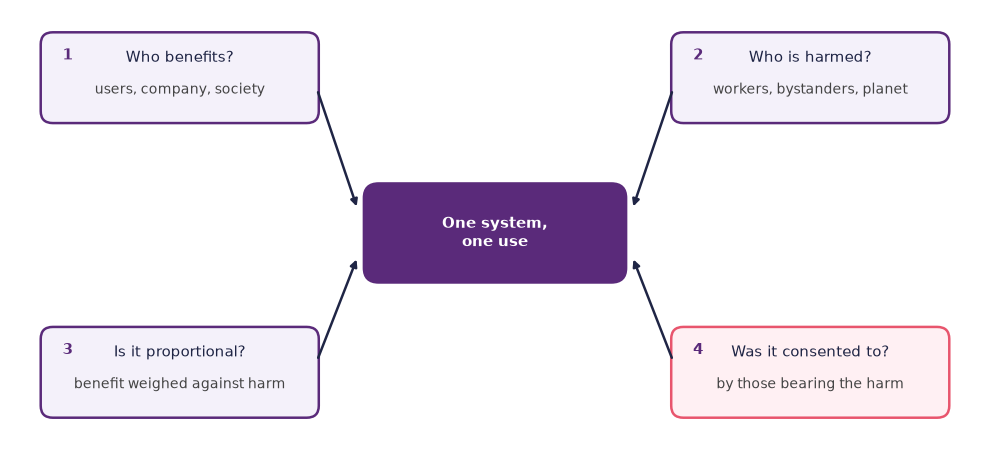
Figure: The four questions point inwards at one system and one use at a time, because asked of AI in general they have no answer.
Two notes on how to use them. First, answer them about a specific system and a specific use, never about “AI” in general, because the general answer is always both yes and no. Second, question four is the one that most often changes your mind, since a harm that everyone affected has agreed to is a different object from one imposed on people who were never asked.
Question two is easier to answer with a vocabulary for the harms themselves. Shelby and colleagues reviewed the research literature on algorithmic harm and sorted what they found into five kinds Shelby et al., 2023. Representational harms reproduce a stereotype or erase a group, as when an image model draws every nurse as a woman. Allocative harms withhold an opportunity or a resource, such as a job advertisement that only some applicants are ever shown. Quality-of-service harms arise when a system simply works worse for some people, like a transcription tool that stumbles on a regional accent. Interpersonal harms are those a system enables between people, such as harassment with a cloned voice. Societal harms land on shared structures, among them a labour market, a news ecosystem and the climate. The labels matter less than the habit they build, since a harm you can name is a harm you can check for, and each of the five topics below touches several of them.
The five topics below are the places where those four questions bite hardest. Each ends with a short list of things you can actually do, because an ethics you cannot act on is a mood rather than a position.
Five topics where the questions bite hardest
Copyright, consent and training data
The largest open legal question as of 2026 is whether training a model on copyrighted material is fair use. Different jurisdictions have given different answers, and many cases are still being litigated.
The factual situation is reasonably clear even where the law is not.
- Most foundation models were trained on massive web-scraped datasets containing copyrighted text, images, music, and code, gathered without explicit permission from the authors.
- The companies argue that this is fair use, fair dealing, or covered by a text-and-data-mining exception.
- Authors, artists, photographers, musicians, and game studios argue that it is mass infringement.
- In the EU there is a text-and-data-mining exception with an opt-out under the 2019 copyright directive. In the US and UK, cases filed from 2023 onwards, among them Andersen v. Stability AI United States District Court, Northern District of California, 2023 and Getty Images v. Stability AI High Court of Justice (UK),US District Court, District of Delaware, 2023, are shaping the doctrine, though as of early 2026 several of them have narrowed, settled, or been decided on secondary questions rather than producing a clear ruling on training itself.
Notice that an opt-out regime and an opt-in regime distribute the same work in opposite directions. Under opt-out, every rights holder must find every crawler and object; under opt-in, every model builder must find every rights holder and ask. Whichever way the burden falls, it falls on thousands of people who have no legal department, and on a handful of organisations that do. The direction matters most for institutions holding other people’s work. For a library or an archive with millions of items whose rights sit with third parties, an opt-in rule can make lawful use of its own collection practically impossible to arrange. An opt-out rule, meanwhile, quietly delivers that collection into training sets its depositors never agreed to.
Source
from matplotlib.patches import FancyBboxPatch, Rectangle

import matplotlib.pyplot as plt
plt.rcParams.update({
    "font.size": 10,
    "axes.titlesize": 11,
    "axes.labelsize": 10,
    "xtick.labelsize": 9,
    "ytick.labelsize": 9,
    "legend.fontsize": 9,
    "figure.figsize": (10, 4),
    "figure.dpi": 100,
    "savefig.dpi": 150,
    "axes.spines.top": False,
    "axes.spines.right": False,
})

navy, purple, rose = "#1f2545", "#5a2a7a", "#e8556d"

fig, ax = plt.subplots(figsize=(10, 4.4))

lanes = [
    ("Opt-out", "every rights holder must find\nevery crawler and object",
     "In the training set\nunless somebody objects", "#fff0f3", rose),
    ("Opt-in", "every model builder must find\nevery rights holder and ask",
     "Outside the training set\nunless somebody agrees", "#f4f1fa", purple),
]

for index, (name, burden, outcome, face, edge) in enumerate(lanes):
    y = 2.35 - index * 1.9
    ax.add_patch(FancyBboxPatch((0.2, y - 0.05), 1.9, 1.25,
                                boxstyle="round,pad=0.02,rounding_size=0.14",
                                facecolor=face, edgecolor=edge, linewidth=1.8))
    ax.text(1.15, y + 0.575, name, ha="center", va="center", fontsize=11,
            fontweight="bold", color=navy)

    for column in range(4):
        for row in range(3):
            ax.add_patch(Rectangle((2.6 + column * 0.28, y + 0.14 + row * 0.36),
                                   0.2, 0.26, facecolor="#fbfaff",
                                   edgecolor="#b9b4c4", linewidth=1.0))
    ax.text(3.15, y - 0.2, "thousands of\nrights holders", ha="center", va="top",
            fontsize=9, color="#444444")

    ax.annotate("", xy=(7.0, y + 0.575), xytext=(4.0, y + 0.575),
                arrowprops=dict(arrowstyle="-|>", color=edge, lw=2.0))
    ax.text(5.5, y + 0.75, burden, ha="center", va="bottom", fontsize=10,
            color="#444444")

    ax.add_patch(FancyBboxPatch((7.2, y - 0.05), 4.0, 1.25,
                                boxstyle="round,pad=0.02,rounding_size=0.14",
                                facecolor=face, edgecolor=edge, linewidth=1.8))
    ax.text(9.2, y + 0.575, outcome, ha="center", va="center", fontsize=10,
            color=navy)

ax.text(5.6, -0.4, "the same works, the same crawlers, and the burden of acting "
        "moved from one side to the other", ha="center", fontsize=10, color=navy)

ax.set_xlim(0, 11.4)
ax.set_ylim(-0.7, 3.9)
ax.axis("off")
plt.tight_layout()
plt.show()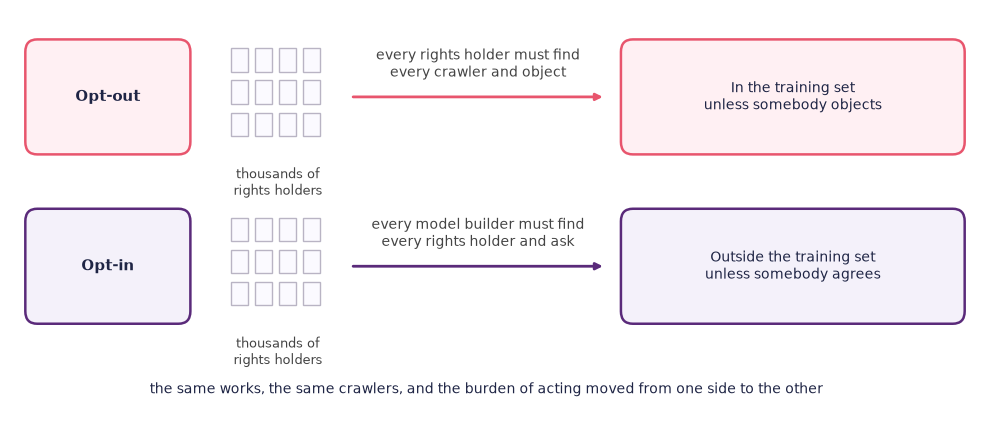
Figure: An opt-out regime and an opt-in regime cover the same works and the same crawlers, and they differ only in which side has to act for material to be included.
Both regimes share an assumption, which is that consent is a single event: a box ticked once, or a file placed once on a server. Medical research met the same problem earlier. A biobank keeps samples for decades and uses them in studies nobody had imagined when the donor signed the form. One answer was dynamic consent, an ongoing arrangement in which participants can see how their material is used and change their decision over time Kaye et al., 2015. Applied to training data, the same idea would let an artist withdraw from future training runs, see which models their work has reached, and agree to some uses but not others. It is a useful yardstick when you compare tools, because it asks not only whether consent was given but whether it can still be withdrawn.
What you can do:
- Honour opt-outs. If you train or fine-tune anything, respect
robots.txt,ai.txt, and platform-level opt-out registers. The Spawning coalition maintains tools for both sides of this Spawning, 2024. - Use licensed data for commercial or sensitive work where you can. Several image and music tool vendors now train on licensed or in-house corpora and say so in writing.
- Be honest about provenance in your own outputs, including which tool produced which part.
Bias and representation
Chapter 2 described bias as a property of the data, propagated by an averaging process that is working correctly. This chapter asks what follows from that.
If the training data over-represents English, Western, urban, web-published, well-photographed, and predominantly male material, the model will reflect that, sometimes obviously and sometimes invisibly. You can see the obvious version in an afternoon.
- Ask an image model for “a CEO” with no further qualifiers, and count the proportion of men.
- Ask a chat model for “a typical Norwegian breakfast”, and count how much of the list is actually eaten in Norway.
- Ask a code model to write a sorting function, and note which programming language it defaults to.
- Ask a music model for “a wedding song”, and note which culture’s wedding it assumes.
These are the legible biases, and they are the easy case precisely because you can see them. The harder cases are quieter. They include stereotyped associations that only show up across many samples, dialects the model has barely heard, accents that get mis-transcribed, and faces that a detector does not find. They also include languages in which the output is simply worse without ever announcing that it is worse. Minority cultural expressions carry the sharpest version of this, since Norwegian folk music, Sámi joik, and other small repertoires are the material most likely to be absent from a model and most easily flattened when it is present.
Naming this as bias understates it. Decolonial critics argue that the problem is not a skewed sample to be corrected but a settled assumption about whose knowledge counts as common, which survives every attempt to rebalance a dataset.
Several ethical traditions outside the Western mainstream start from relationships rather than rules, and they offer a vocabulary for what this critique is pointing at. Gilligan’s ethics of care treats responsibility as a response to particular people in particular situations rather than as the application of an abstract principle Gilligan, 1982. Ubuntu, often summarised as “a person is a person through other persons”, judges an action by whether it builds or damages the relationships of a community Metz, 2007. The Andean idea of buen vivir, sumak kawsay in Kichwa, measures a good life through a person’s relations to a community and to nature, and Ecuador wrote it into its constitution in 2008 Republic of Ecuador, 2008. Asked of a generative tool, the relational question is not only whether each user got a good result. It is also what the tool does to the relationship between the people whose work it was trained on and the people who now use it.
Bender and colleagues’ “Stochastic Parrots” paper remains the canonical critical text on why scale alone does not fix this Bender et al., 2021, and Crawford situates the question inside the wider structures of extraction and labour that produce these systems Crawford, 2021.
A published evaluation deserves the same scrutiny as the model it evaluates. A benchmark is a set of test cases that someone chose, and it encodes that person’s picture of who uses the system, for what, and what could go wrong Raji et al., 2021. A safety test written by one team in one city tends to imagine a technically skilled attacker. It rarely includes the slow harms of cultural misreading or gradual exclusion, because the team may never have lived in the places where those harms happen. Every deployed system also runs with an error rate that someone decided was acceptable. Setting that threshold decides whose errors are tolerable, which makes it a political decision presented as a technical one.
It follows that a community can have good reasons to refuse a system that has passed every test its makers ran. The CARE principles for Indigenous data governance, which stand for collective benefit, authority to control, responsibility and ethics, give a community a say over which of its material is in scope at all Carroll et al., 2020. A community may decide that some of its material, a sacred song or a personal joik, should never enter a training set, however well the resulting model would score.
What you can do:
- Audit your outputs for representation, especially in work that will be public. Ten prompts and a tally sheet is a real audit.
- Prompt and condition deliberately when generating people, using explicit descriptions and reference images rather than leaving the default to the average.
- Document failures when you see them, in your log and, where there is a channel, to the vendor. Flagged failures do get fixed in later training cycles.
- Prefer tools that publish bias evaluations, which by 2026 a growing minority of them do.
Labour
Generative AI sits on a foundation of human labour that is rarely visible in the interface.
- Data workers, often in low-wage countries, label images, rank model outputs, and write fine-tuning examples. They are the reason a model behaves the way it does, and some of them carry the psychological cost of moderating violent and abusive material Broussard, 2018.
- Artists whose work was used for training, often without consent, payment, or attribution.
- Voice actors asked to record samples that are later used to synthesise the work they would otherwise have been paid to do.
- Creative professionals whose markets are reshaped by tools trained on their own earlier output.
None of this is unique to AI. Every wave of automation reorganises labour, and Pasquinelli’s history of the field argues that machine intelligence has always been a formalisation of the division of labour rather than an escape from it Pasquinelli, 2023. What is sharper this time is the speed, and the fact that the training material came from the very people whose position is now weaker.
Behind the individual contract sits an infrastructure most creators never see. Collecting societies register works, match a use to an owner, and distribute royalties, and they depend on ownership databases that are incomplete and inconsistent across countries. Generated content strains that system in two directions at once, because the volume of registrations rises while the question of who owns a given track becomes harder to answer.
What you can do:
- Pay for tools that pay their data workers decently and license their training material, and treat the cheapest option as a question rather than a default.
- Credit and pay human collaborators when you publish AI-assisted work, including the ones whose contribution was the brief rather than the file.
- Push your employer or institution towards AI policies that protect contractors, freelancers, and students.
- Read your contracts. Many platforms now insert clauses that license your uploads for training.
Sustainability
Training a large model uses a great deal of electricity, water, and rare materials. Inference, meaning everyday use, uses far less per query but far more in aggregate, because the queries never stop. Strubell and colleagues put the training side on the map in 2019 with estimates for language models that were small by later standards Strubell et al., 2019, and models have grown by orders of magnitude since.
The inference side has better numbers than it used to. Luccioni, Jernite, and Strubell measured many tasks on the same hardware and found that the cost per query depends far more on what you ask for than on how much you ask Luccioni et al., 2024. Generating one image cost roughly sixty times the energy of generating a paragraph of text, and around 1 450 times the cheapest task they measured, text classification. Summarisation and image captioning fall between those extremes. The ranges within a task were wide, spanning more than an order of magnitude across models, which means that choosing a smaller model for a routine job is often a larger saving than cutting the job itself. Multimodal generation, where one model handles several kinds of data, and long-reasoning modes multiply the figure again, because they run the expensive kind of task repeatedly.
Source
import numpy as np

import matplotlib.pyplot as plt
plt.rcParams.update({
    "font.size": 10,
    "axes.titlesize": 11,
    "axes.labelsize": 10,
    "xtick.labelsize": 9,
    "ytick.labelsize": 9,
    "legend.fontsize": 9,
    "figure.figsize": (10, 4),
    "figure.dpi": 100,
    "savefig.dpi": 150,
    "axes.spines.top": False,
    "axes.spines.right": False,
})

navy, purple, rose = "#1f2545", "#5a2a7a", "#e8556d"
tasks = ["Text classification", "Text generation", "Summarisation",
         "Image captioning", "Image generation"]
energy = np.array([0.002, 0.047, 0.049, 0.063, 2.907])

fig, ax = plt.subplots(figsize=(10, 3.6))
colours = [purple] * (len(tasks) - 1) + [rose]
positions = np.arange(len(tasks))
ax.barh(positions, energy, color=colours, height=0.6)
for position, value in zip(positions, energy):
    ax.text(value * 1.25, position, f"{value:g} kWh", va="center",
            fontsize=10, color="#444444")

ax.set_yticks(positions)
ax.set_yticklabels(tasks)
ax.set_xscale("log")
ax.set_xlim(0.001, 30)
ax.set_xlabel("kilowatt hours per 1 000 inferences (logarithmic scale)")
ax.grid(axis="x", color="#dcd7e4", lw=0.8, ls=":")
ax.set_axisbelow(True)
for side in ("right", "top"):
    ax.spines[side].set_visible(False)
ax.text(0.0015, 4.55, "each step to the right is ten times the energy",
        fontsize=10, color="#666666")
ax.annotate("about 1 450 times\nthe cheapest task", xy=(2.907, 4),
            xytext=(0.3, 2.45), fontsize=10, color=rose,
            arrowprops=dict(arrowstyle="-|>", color=rose, lw=1.4))

plt.tight_layout()
plt.show()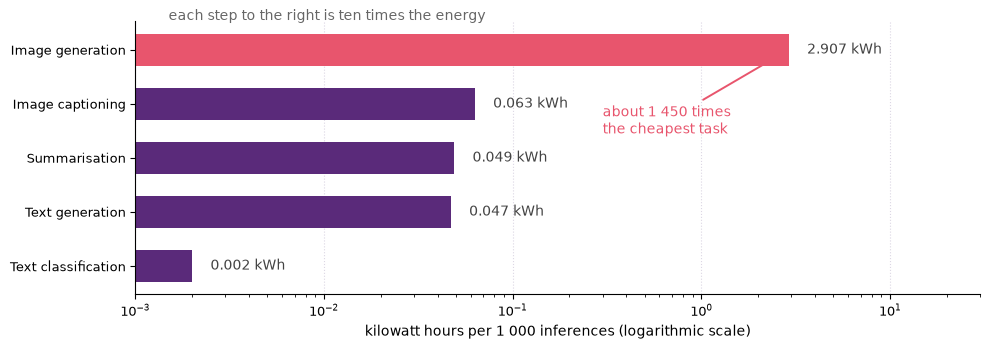
Figure: Energy per 1 000 inferences for five tasks measured on the same hardware, on a logarithmic scale, running from text classification at the cheap end to image generation at the expensive one Luccioni et al., 2024.
Two cautions about that paper, since it is the one most often quoted badly. It measures energy, not water and not carbon, and it measures it on particular hardware for particular models. Turning energy into water requires knowing a specific data centre’s cooling design, and turning it into carbon requires knowing its grid mix at that hour. Operators rarely publish either, which is the real reason confident per-query numbers should make you suspicious. The critical look at the end of this chapter takes that apart properly.
There is a local angle worth naming. Data centres are being built across the Nordics, including in Norway, specifically for AI workloads, and partly because the electricity here is cheap and low-carbon. That is a genuine environmental advantage and a genuine political question at the same time, since the same electricity and the same grid capacity have other possible uses.
Energy per query is only the part of the cost that runs while you watch. A life cycle assessment counts the rest, from the mining and manufacture of the hardware through the water used to cool it to what happens when a data centre is decommissioned.
What you can do:
- Use smaller or distilled models for routine tasks. Most jobs do not need the frontier, and the measured spread between models is large.
- Batch your work. Iterate on cheap drafts before paying for the expensive run.
- Turn off reasoning and multimodal modes when the task does not need them, since they are the expensive settings.
- Prefer vendors that publish compute and energy figures, and say why when you choose one that does.
Authorship, authenticity and the public sphere
Generative AI strains four categories that cultural life has been leaning on for a long time.
Authorship. If a song is seventy per cent generated and thirty per cent yours, who is the author? A streaming platform, a copyright register, a court, and your own conscience may give four different answers, and by 2026 several of those answers had changed at least once. Registers in a number of jurisdictions will not grant protection to work with no human authorship, which makes the question of what counts as a human contribution suddenly practical rather than philosophical.
Authenticity. A photograph of a public figure at a demonstration is no longer evidence that they were there. Audio of a friend asking for money is no longer evidence that they asked. The default assumption that a recording is a trace of an event is over, and nothing has replaced it except provenance infrastructure that is still being built. The C2PA specification for signed content credentials is the most developed attempt Coalition for Content Provenance and Authenticity, 2024, and the EU AI Act requires disclosure for content generated by systems interacting with people European Parliament,Council of the European Union, 2024European Commission, Directorate-General for Communications Networks, Content,Technology, 2024.
The public sphere. Social platforms in 2026 carry a large volume of generated content competing for human attention. Some of it is benign and some of it is deliberate noise aimed at elections and public debate, and the two are not easy to tell apart at speed.
Education. Submitting AI-written work as your own is academic dishonesty, and that has not changed. What has changed is that a generation of students arrived already fluent in these tools, and that institutional policies are still catching up. This course’s answer is documentation rather than prohibition: use what you like, log what you used.
What you can do:
- Label. When you publish AI-assisted work, say so, and attach provenance metadata where the tool supports it.
- Verify. When you receive a striking video, recording, or quotation, check where it came from before you pass it on.
- Resist over-claiming in both directions. These systems are not producing an apocalypse, and they are not a party trick.
The latent space as anarchive
The section on authorship and authenticity left provenance as the practical response to a crisis of authenticity. Before you act on that, ask what the model itself can contribute to provenance: the answer is nothing.
Start with the archive as the humanities have understood it. It holds documents, each document has a provenance, and an institution keeps and classifies them. Antonio Somaini takes that arrangement apart into three apparatuses that have to work together. The technical apparatus is the media that store the traces, and the institutional one is the libraries, museums, and states that collect and order them. The epistemological apparatus is the classifications that decide what can be said about what is stored. The reading follows Derrida, Foucault, and Stiegler, and Somaini set it out in a 2026 lecture in Oslo reported in the post this section draws on Jensenius, 2026 and in a 2026 article on latent spaces and the archive Somaini, 2026.
A trained model is not that, because it holds no documents. Chapter 2 described what it holds instead. It holds a compressed description of where the plausible region is, a latent space in which similar things sit close together. Moving through that space does not retrieve a record. It produces a variation.
Pierre Cassou-Noguès and Gwenola Wagon use the term anarchive for a memory that works this way. Their book, published in French in 2025 and in English in 2026, describes it as a computational system that does not conserve fixed documents but continuously reorganises cultural traces into new generative forms Cassou-Noguès & Wagon, 2026.
Somaini draws three consequences from this, and you have met all three already in this chapter.
- Provenance becomes unstable. You cannot trace an output back to the works that shaped it. That is what makes the consent question of the copyright section so hard to settle case by case, since consent was given, or withheld, at the input, and the output cannot report which.
- Context is stripped. Each trace arrives detached from the conditions of its making, and what survives is the statistical shape of the whole. That is the bias of the previous sections seen from the other side, and it is the same mechanism as the pull towards the average in the individual versus collective paradox.
- Meaning becomes relational. A generated thing means roughly what its neighbours mean. Position among similar items does more work than origin, which is the authenticity problem stated as geometry.
The same account has a name for output that is culturally resonant and tied to no source: ghost memory Jensenius, 2026. It is a useful phrase for the moment when something you generated feels like a quotation you cannot place.
For you as an author the practical point is short. You are not quoting from an archive. You are sampling from an anarchive, so provenance has to be supplied by you: your decisions log, your declaration of AI use, your captions on the published work. The system cannot supply it, and it does not learn to. That is the duty this chapter keeps handing back to you, and the next section asks whose hands, exactly, it lands in.
Death of the Artist or Birth of the Curator?
Here is a deliberately provocative framing for the cultural argument. In 1967 Roland Barthes published The Death of the Author, which shifted interpretive authority away from the writer and onto the reader. In the generative era a parallel debate has opened: does AI dissolve the artist into the model and the dataset, or does it elevate a different figure, the curator, who selects, prompts, edits, refuses, and stands behind the result?
Both readings are partly true, and they are usefully in tension. The argument is not decorative, because it decides:
- what counts as authorship, and what goes into copyright registers;
- who gets credited, and how the people whose labour entered the dataset are paid;
- what is asked of students and professionals by the instruction “do this with AI”;
- what audiences will accept as a published creative artefact.
Salma and colleagues sharpen the second reading with the craftsperson-to-creative-director move from the top of this chapter Salma et al., 2025. Where the death-of-the-artist framing risks erasing the human, the creative-director framing gives the human role a positive and, crucially, a responsible shape. The author of an AI-assisted work is not whoever pressed generate. It is whoever can plausibly own the brief and the choices, which also means whoever can be held to account for them.
That is worth stating as a general rule, because it settles a surprising number of arguments. Responsibility does not distribute across a pipeline. A model cannot hold it, a vendor will disclaim it, and a prompt is not a party to anything. It lands on the person who decided to publish.
None of this is new in kind. Walter Benjamin argued in 1935 that mechanical reproduction detaches a work from the here and now of its making, and that the categories of art criticism would have to be rebuilt around that loss Benjamin, 1968. McCormack and colleagues run a version of the same argument for computer-generated art specifically, separating autonomy, authenticity, authorship, and intention into four questions that a single word had been hiding McCormack et al., 2019. What is new is the scale, and the fact that the prior work is inside the machine rather than merely reproduced by it.
This week’s ethics essay, set in this week’s lab below, is your chance to take a real position on this tension, or on a different one, and defend it.
Three futures, as a foresight exercise
Nobody knows where this is going. Very few people predicted in 2022 what 2026 would look like, and predicting 2030 from here is at least as hard. What you can do instead of predicting is map the space, which is what strategic foresight practitioners call a scenarios exercise. You write several futures that are each internally coherent, and then ask what your own work looks like inside each one.
Three sketches are enough to cover most of the space.
Source
import numpy as np
from matplotlib.patches import Polygon

import matplotlib.pyplot as plt
plt.rcParams.update({
    "font.size": 10,
    "axes.titlesize": 11,
    "axes.labelsize": 10,
    "xtick.labelsize": 9,
    "ytick.labelsize": 9,
    "legend.fontsize": 9,
    "figure.figsize": (10, 4),
    "figure.dpi": 100,
    "savefig.dpi": 150,
    "axes.spines.top": False,
    "axes.spines.right": False,
})

navy, purple, rose = "#1f2545", "#5a2a7a", "#e8556d"

fig, ax = plt.subplots(figsize=(10, 4.4))

origin = np.array([0.9, 2.7])
futures = [
    ("A: AI as electricity", "it fades into the infrastructure",
     "the creator directs and curates", 1.9, "#f4f1fa", purple),
    ("B: AI as collaborator", "models keep recognisable temperaments",
     "the creator casts and negotiates", 0.0, "#f4f1fa", purple),
    ("C: AI as flood", "output outruns the attention to judge it",
     "the creator joins a trust network", -1.9, "#fff0f3", rose),
]

for name, gloss, craft, spread, face, edge in futures:
    shoulder = 4.4
    corners = [origin,
               origin + np.array([shoulder, spread + 0.85]),
               origin + np.array([9.0, spread + 0.85]),
               origin + np.array([9.0, spread - 0.85]),
               origin + np.array([shoulder, spread - 0.85])]
    ax.add_patch(Polygon(corners, closed=True, facecolor=face,
                         edgecolor=edge, linewidth=1.6, alpha=0.9))
    ax.text(9.72, origin[1] + spread + 0.34, name, ha="right", va="center",
            fontsize=11, fontweight="bold", color=navy)
    ax.text(9.72, origin[1] + spread + 0.02, gloss, ha="right", va="center",
            fontsize=10, color="#444444")
    ax.text(9.72, origin[1] + spread - 0.30, craft, ha="right", va="center",
            fontsize=10, color=edge, style="italic")

ax.plot(*origin, "o", color=navy, markersize=10, zorder=5)
ax.text(origin[0] - 0.15, origin[1], "2026", ha="right", va="center",
        fontsize=11, fontweight="bold", color=navy)
ax.plot([6.4, 6.4], [0.05, 5.5], color="#8f8a9c", lw=1.2, ls="--")
ax.text(6.4, 5.62, "2030", ha="center", va="bottom", fontsize=10, color="#666666")
ax.text(5.6, -0.5, "the three overlap, and pieces of all of them are visible already",
        ha="center", fontsize=10, color=navy)

ax.set_xlim(-0.4, 10.6)
ax.set_ylim(-0.8, 6.1)
ax.axis("off")
plt.tight_layout()
plt.show()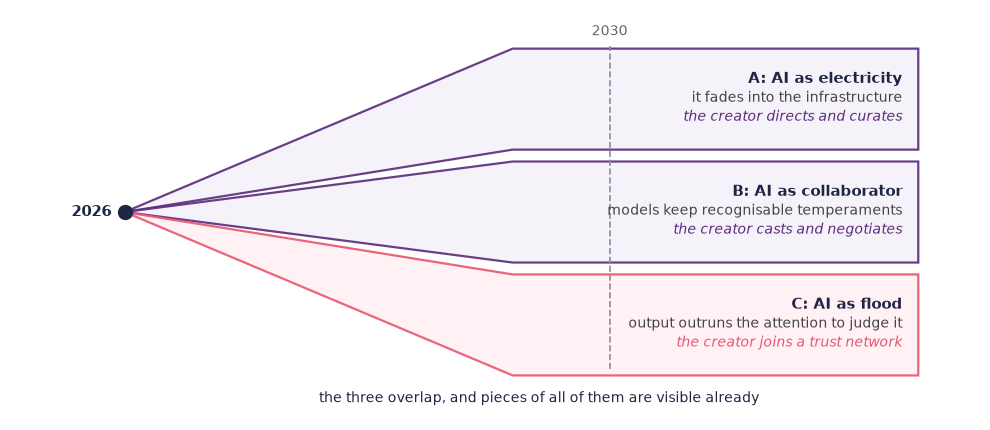
Figure: Three scenarios fanning out from 2026, each one internally coherent, and each implying a different craft for the person making the work.
Future A: AI as electricity
Generative AI fades into the background, the way the internet did in the 2000s and the cloud did in the 2010s. Every tool has AI features and nobody calls them AI features any more. The technology becomes infrastructure, and the interesting work moves up the stack to design, story, taste, and ethics.
Creators in this future spend less time on production craft, which is largely automated, and more on direction, curation, and editorial judgement. Small studios produce work that used to need large teams, and new genres emerge from the sheer cheapness of iteration.
Future B: AI as collaborator
Generative AI stays in the foreground as a distinct kind of collaborator. Models have recognisable sensibilities, and studios select one the way they cast an actor. Reputation systems emerge for human and machine contributors alike, and legal and labour frameworks adapt to the hybrid mode rather than fighting it.
Creators in this future learn a new craft, which is casting: knowing which model has which temperament, which can carry which kind of work, and which pairs well with which human collaborator. The line between making and directing becomes openly continuous.
Future C: AI as flood
Generative output scales past the human capacity to attend to it or evaluate it. Most published content is generated, most of it is mediocre, and all of it competes for the same attention. Search degrades, platforms degrade, and public discourse degrades with them. Human-made and human-curated work commands a premium in the way handmade goods do today.
Creators in this future organise into trust networks where provenance, slowness, and verifiable authenticity are the value proposition. Institutions with a reason to be trusted, such as libraries, universities, and public broadcasters, become more important rather than less.
Using the three
These futures are not exclusive, and pieces of all three are already visible in 2026. The point of the exercise is not to bet on one. It is to ask, in each of them, what does my discipline look like, and what is my job called? Answer that three times and you will usually find that one or two skills survive in all three scenarios, and those are the ones worth building this year.
The question of what stays human across all three is where the course ends, in chapter 12. For now, notice that your answer will already be shaped by the four questions above, since a future is only attractive if you are willing to say who pays for it.
A small personal toolkit
Three habits are worth committing to as a creator in 2026, and all three are cheap.
- Keep a decisions log. For every project: which tools, which prompts, which edits, which versions you kept, and why. It protects you legally, it makes your process teachable, and it is the raw material for every reflection you will write this semester.
- Treat a model like a freelancer. Ask what it was trained on, check the work, credit the contribution, and do not assume good faith about rights clearance.
- Refuse cheerfully. It is entirely respectable, and increasingly useful, to say “I am not using AI for this part”, not as ideology but as craft. A practice that can say no in one place is more trustworthy everywhere else.
This week’s lab: Explore, Reflect, Create
This is the most reflection-heavy lab of the semester, so treat the timings below as indicative. The debate in Reflect usually overruns its fifteen minutes, and the audit in Explore is designed to be started in the session and finished at home.
Explore (about 30 min)
Audit one tool. Pick a Creative AI tool you have used this semester and write a short ethical audit of it, using the four questions from A simple ethical frame above. Cover five things.
- Provenance. What does the vendor say publicly about the training data? Quote it, and note what it does not say.
- Bias. Run a probing set of ten prompts that touch gender, geography, and language, and tally what comes back. Ten prompts and a tally is enough to be evidence.
- Labour. What do you know, or can you find out, about the people who labelled and moderated the data?
- Sustainability. Does the company publish anything about compute, energy, or water? If not, note that too.
- Authorship and labelling. Does the tool offer content credentials, watermarking, or any provenance metadata?
Aim for 600 to 1 000 words. This is empirical work: you are investigating a real system, not summarising opinions about it. Start it in the session and finish it at home, because it is the seed material for the essay.
Reflect (about 15 min)
Structured debate. Two teams of three or four. Each team draws a position at random:
- “Training generative models on copyrighted material is acceptable as fair use.”
- “Training generative models on copyrighted material is not acceptable without per-rights-holder consent.”
You defend the position you drew, whatever you personally think. This is deliberate. Being able to build the strongest version of a case you disagree with is the single most useful skill in applied ethics, and it is also the fastest way to find the weak joint in your own view.
If your group settles its position early, take one more round on a harder version of the same question: is the training set an archive or an anarchive, and does the answer change what the opt-in versus opt-out question means?
Close the round by going round the room, with each student naming aloud the essay prompt they intend to take. Saying it in front of other people is the point.
Create (about 45 min)
A one-page AI policy. Imagine you are the head of a small university department, a music ensemble, a newsroom, or a design studio. Draft a one-page AI use policy for that imagined organisation, covering:
- three things you would mandate, for example declaration of AI use, provenance metadata, an energy budget, or opt-out checks;
- three things you would prohibit, for example voice cloning without explicit consent, training on private student work, or undeclared agent use in publications;
- one open question you would put to an expert before signing it.
Keep it to one page, since real organisational policies are short. Commit it to your portfolio as ai-policy.md.
At home, write this week’s entry in your practice log using the practice log template.
A critical look: does one image cost a bottle of water?
The claim. Every AI image you generate consumes about a bottle of water, and every chat query consumes a mouthful. The figure circulates widely, usually with no source, and is used to argue that individual use is the problem.
The evidence. There is real measurement underneath the slogan, and it does not say what the slogan says. The figures quoted in the sustainability section come from Luccioni, Jernite, and Strubell, who ran many tasks on the same hardware and reported energy per query, not water Luccioni et al., 2024. Two features of their result matter here: the spread by task is enormous, and so is the spread between models doing the same task. On the training side, Strubell and colleagues had already shown in 2019 that a single large training run carried a substantial carbon cost, and models have grown considerably since Strubell et al., 2019.
The method. Turning any of that into bottles requires three further steps, and each one is an assumption rather than a measurement. First, you pick a model and a task, and the choice alone moves the answer by an order of magnitude. Second, you convert energy into water using a cooling ratio, litres per kilowatt-hour, which depends on the individual data centre’s cooling design, its local climate, and the season. Third, you attribute a share of the site’s total water, including the water used to generate the electricity, back to your single query. Operators rarely publish the numbers any of those steps need, so published estimates fill the gaps with plausible defaults and then present the product as a measurement.
The limits. Order-of-magnitude claims here are defensible and worth making: image generation really is far more expensive than text classification, reasoning and multimodal modes really do multiply the cost, and the aggregate really is large. Precise per-query figures in bottles are not defensible, and quoting them hands an easy rebuttal to anyone who would rather not discuss the aggregate at all. The honest formulation states the assumptions with the number, which is also why the estimator app for this chapter shows its working rather than a single figure. And notice what the individual framing hides. The decisions with real leverage are which model a service defaults to, where the data centre is built, and what the grid runs on, none of which is settled by your restraint at the prompt box.
- Salma, Z., Hijón-Neira, R., & Pizarro, C. (2025). Designing Co-Creative Systems: Five Paradoxes in Human–AI Collaboration. Information, 16(10), 909. 10.3390/info16100909
- UNESCO. (2022). Recommendation on the Ethics of Artificial Intelligence. United Nations Educational, Scientific. https://unesdoc.unesco.org/ark:/48223/pf0000381137
- Regulation (EU) 2024/1689 — The AI Act. (2024). European Parliament. https://eur-lex.europa.eu/eli/reg/2024/1689/oj
- Shelby, R., Rismani, S., Henne, K., Moon, Aj., Rostamzadeh, N., Nicholas, P., Yilla-Akbari, N., Gallegos, J., Smart, A., Garcia, E., & Virk, G. (2023). Sociotechnical Harms of Algorithmic Systems: Scoping a Taxonomy for Harm Reduction. Proceedings of the 2023 AAAI/ACM Conference on AI, Ethics, and Society (AIES), 723–741. 10.1145/3600211.3604673
- Andersen v.\ Stability AI Ltd. (2023). United States District Court, Northern District of California. https://www.theverge.com/2024/8/13/24219520/ai-art-copyright-lawsuit-stability-midjourney-deviantart-runway
- Getty Images v.\ Stability AI. (2023). High Court of Justice (UK). https://www.theverge.com/2023/2/6/23587393/ai-art-copyright-lawsuit-getty-images-stable-diffusion
- Kaye, J., Whitley, E. A., Lund, D., Morrison, M., Teare, H., & Melham, K. (2015). Dynamic Consent: A Patient Interface for Twenty-First Century Research Networks. European Journal of Human Genetics, 23(2), 141–146. 10.1038/ejhg.2014.71
- Spawning. (2024). Spawning — Opt-out and Consent Tools for AI Training Data. Spawning Inc. https://spawning.ai/
- Gilligan, C. (1982). In a Different Voice: Psychological Theory and Women’s Development. Harvard University Press.
- Metz, T. (2007). Toward an African Moral Theory. Journal of Political Philosophy, 15(3), 321–341. 10.1111/j.1467-9760.2007.00280.x
- Republic of Ecuador. (2008). Constitution of the Republic of Ecuador. https://pdba.georgetown.edu/Constitutions/Ecuador/english08.html
- Bender, E. M., Gebru, T., McMillan-Major, A., & Shmitchell, S. (2021). On the Dangers of Stochastic Parrots: Can Language Models Be Too Big? Proceedings of the ACM Conference on Fairness, Accountability, and Transparency (FAccT). 10.1145/3442188.3445922
- Crawford, K. (2021). Atlas of AI: Power, Politics, and the Planetary Costs of Artificial Intelligence. Yale University Press. https://yalebooks.yale.edu/book/9780300264630/atlas-of-ai/
- Raji, I. D., Bender, E. M., Paullada, A., Denton, E., & Hanna, A. (2021). AI and the Everything in the Whole Wide World Benchmark. Proceedings of the Neural Information Processing Systems Track on Datasets and Benchmarks. https://arxiv.org/abs/2111.15366
- Carroll, S. R., Garba, I., Figueroa-Rodríguez, O. L., Holbrook, J., Lovett, R., Materechera, S., Parsons, M., Raseroka, K., Rodriguez-Lonebear, D., Rowe, R., Sara, R., Walker, J. D., Anderson, J., & Hudson, M. (2020). The CARE Principles for Indigenous Data Governance. Data Science Journal, 19, 43. 10.5334/dsj-2020-043