Introduction
You are reading the open textbook for Creative AI, a bachelor-level course at the University of Oslo (UiO). The course runs for twelve weeks, with three 45-minute blocks each week (a 45-minute lecture and a 90-minute lab), and it is open to students from all faculties.
There are no prerequisites. You need no programming, no machine learning, and no training in any particular art form; basic digital literacy is assumed, and curiosity from your own discipline matters more than any specific background. The book is also written for self-study, and as a public resource for anyone curious about creative uses of AI.
The aim of the course is twofold. The first aim is to give you a working understanding of how today’s generative AI systems are built and why they behave the way they do. The second is to give you hands-on experience of using these systems for creative work, together with the critical vocabulary needed to discuss their cultural, ethical, and environmental consequences. Neither aim works without the other: understanding without practice stays abstract, and practice without understanding leaves you at the mercy of whatever the tool happens to do.
Three concepts thread through every week: intentionality, aesthetic control, and ethical authorship. The interesting question is not can the model do this, but what do you want, how do you guide the system there, and on whose terms.
Course at a glance
| Field | Value |
|---|---|
| Course title | Creative AI |
| Level | Bachelor, open to students from all UiO faculties |
| Credits | 10 ECTS (suggested) |
| Duration | 12 teaching weeks |
| Format per week | 45 min lecture + 90 min practice-based lab |
| Workload | ≈ 6 hours of self-study and project work per week |
| Prerequisites | None. Basic digital literacy assumed; no programming required. |
| Language | English (with discussion in Norwegian as needed) |
| Teaching team | Coordinator + invited guest lecturers from across UiO faculties |
| Exam format | A portfolio, delivered as an exposition on the Research Catalogue in the exam period |
| Assessment | Exam: the portfolio, graded A to F. Four compulsory assignments, pass or fail, must be approved to sit the exam. |
Course description (for the course catalogue)
Artificial intelligence has moved from a back-office technology into a tool that shapes everyday creative work: writing, drawing, photography, music, video, design, code, journalism, scholarship, and teaching. Creative AI introduces students from across the University of Oslo to the concepts, tools, and ethics of working creatively with contemporary AI systems.
The course assumes no prior programming or specialised art background. Through a combination of short lectures and weekly hands-on labs, students learn how today’s text, image, sound, video, and multimodal models work. They also learn how to direct and refine their outputs, how to integrate them responsibly into their own discipline, and how to reflect critically on the cultural, legal, environmental, and political stakes of the technology.
Every lab follows the same three phases, in the order Explore, Reflect, Create. Students leave the course with a portfolio of creative AI artefacts and a documented prompt and decisions log. The portfolio is the exam. It holds the four compulsory assignments, revised after feedback, a final piece made in the last weeks of the course, and a critical reflection. It is delivered in the exam period as an exposition on the Research Catalogue, an open platform for artistic research. The four assignments are compulsory and assessed pass or fail.
Five layers
Any Creative AI system can be described at five layers. They run from what goes into the system to what it changes once it reaches the world, and each layer comes with its own set of questions.
| Layer | What it covers | Question it answers |
|---|---|---|
| Data | Training corpora, provenance, consent, bias, labour | What went in? |
| Model | Architectures, training, sampling, conditioning, capabilities and limits | What can it do, and why? |
| Interface | Prompts, briefs, controls, tools, agents, bodies | How do you steer it? |
| Practice | Workflows, craft, iteration, documentation, collaboration | How do you make good work with it? |
| Culture | Authorship, aesthetics, law, economy, environment, futures | What changes when it enters the world? |
Every chapter opens by naming the layer or layers it works at, so that you always know which questions are in play. The five layers give a shared vocabulary for describing very different systems at the right level of detail. They earn their place for one reason: many disagreements about AI turn out to be disagreements about which layer the two parties are standing on.
Course schedule
The twelve-week schedule maps the lectures and labs. The labs deliberately mix modes. Some weeks you work with tools in a browser; other weeks you read a model card, sketch a pipeline on paper, or run a few lines of Python in a notebook on your laptop or in UiO Educloud.
| Week | Chapter | Layer | Lecture (45 min) | Lab (90 min) |
|---|---|---|---|---|
| 1 | AI and creativity | culture | History from Dada to diffusion; definitions; the five layers | First generations in one text and one image tool; start the practice log |
| 2 | Generative AI | data, model | Data, models, training, inference; sampling and conditioning | Model card reading; same prompt, three samplers; training-loop and sampler apps |
| 3 | Authorship and ethics | culture | Five paradoxes; craftsperson to creative director; copyright, bias, labour, energy; three futures as foresight | Debate; audit one tool; draft an AI policy |
| 4 | Language and AI | interface | LLMs, tokens, context, prompting, failure modes | Hallucination hunt; two-model comparison; prompt library |
| 5 | Images and AI | model, interface | Diffusion, control signals, editing, series consistency | One-variable experiment; image-to-image; a finished series |
| 6 | Sound, music and AI | practice | Speech, voice, music, sound design; from analysis to generation | Transcribe and re-voice with consent; a 30-second piece |
| 7 | Video and AI | model | The time axis; consistency; image-to-video; deepfakes; world models | Storyboard to three shots with a provenance card |
| 8 | 3D, XR and AI | practice | Capture, generation, VR/AR/XR pipelines, game assets | Capture a splat or place an asset in a scene or headset |
| 9 | Creative coding | practice | Assistants, reading code, p5.js, tiny AI-powered web tools | Mouse-reactive sketch with an assistant |
| 10 | Multimodal AI | model | Shared representations; models that see, hear, and speak | Multimodal critique; translation between data types |
| 11 | Agentic AI | interface | Loops, tools, briefs, supervision, cost, safety | Design a pipeline; run a small agent on one slice; agent-loop app |
| 12 | Embodied AI | practice, culture | Embodiment and 4E cognition; musicking robots; what stays human | Rhythm-bot session; sensor-to-generator mapping; peer review of exposition drafts |
| exam period | The portfolio exposition | — | — | The portfolio, handed in as an exposition on the Research Catalogue |
Five pages sit outside the weekly rhythm. This overview is the first of them. Tips and tricks gathers the craft that carries across tools: prompt patterns, decision logs, how to write and cite AI-made work, accounts and privacy at UiO, and how to prepare the portfolio exposition. It ends with ways to give something back to the open commons. The glossary collects the key terms defined in the chapters, as a lookup list for revision. The tools page lists the tool categories used in the course, with current examples, an open alternative in each category, and the small web apps built for this book. The portfolio exposition page describes the exam: what the portfolio holds, the requirements, the outline, how to hand it in, and the archive of past cohorts.
Explore, Reflect, Create
Every lab runs in the same order, and every chapter uses the same three subheadings for it. These are not separate assignments, but three modes of engagement that together make up a Creative AI practice, and the order matters: exploring comes before deciding, and deciding comes before making.
- Explore (about 30 minutes). Controlled experiments with the week’s tool: vary one thing, compare two tools, break something on purpose. This is where the model surprises you.
- Reflect (about 15 minutes). A structured discussion in pairs or in plenary, not a writing block. It ends with each student stating one intention for what they will make. This is where you decide.
- Create (about 45 minutes). Make the artefact you stand behind, and carry it over into your portfolio at home. This is where you exert your will.
- Log (at home). The three-paragraph weekly entry, one paragraph each on Explore, Reflect, and Create, closes the loop as the retrospective.
The cycle maps onto the two questions you will answer in every process memo. Explore is where you meet surprise, the moment a system does something you did not predict. Create is where you exert your will, the moment you decide what the work should be and bend the output towards it. Reflection sits between them, turning a surprise into an intention.
Weeks 3 and 12 bend the timings, since the ethics week is reflection-heavy and the final week reserves time for peer review of the exposition drafts, but the order stays the same.
Each phase also names a disciplinary way into the subject, so that whatever you studied before, one of the three is already familiar ground.
Explore
Use AI-based systems in creative practice, and see how creative methods can be applied in other domains. This is the applied and behavioural track: psychology, therapy, educational sciences, cultural heritage. Explore activities investigate how AI can enhance creativity, foster innovation, and support learning and well-being, by trying things and documenting what the tools actually afford.
Typical outputs: controlled experiments (same prompt, vary one knob); prompt comparisons across two tools; hallucination hunts; model-card analyses; tool-to-task mappings; failure-mode catalogues.
Reflect
Critically study and discuss the impacts of AI on humans, human creativity, cultures, and society at large. This is the humanities and social sciences track: ethics, history, aesthetics, politics, law, learning. Reflect activities ask why the work is being done, who pays for it, who benefits, and who is left out.
Typical outputs: in-class debates; ethical audits; comparative readings of two tools or two cases; honest captions and provenance notes for your own work; the middle paragraph of your weekly log.
Create
Make AI-based systems, tools, artworks, frameworks, and policies. This is the making track: computer science, engineering, art, design, with an explicit emphasis on co-creative AI systems that prioritise human agency, environmental sustainability, and the democratisation of AI technologies. Each lab leaves you with a concrete artefact for your portfolio.
Typical outputs: images, songs, short videos, code sketches, design pipelines, prototype agents, policy briefs, exhibition pieces.
How the three connect
The three modes reinforce one another. Explore asks what the tool actually does; Reflect asks why you are doing this and at whose cost; Create asks what you can make, with that understanding, that you are willing to stand behind. A good Creative AI practitioner never separates them for long.
The rhythm also maps onto the disciplinary breadth of the course, and of the co-creative AI research at RITMO and the fourMs Lab that gave the course its shape. Applied and behavioural sciences sit on the Explore side, humanities and social sciences on the Reflect side, and computer science, engineering, art, and design on the Create side. Students from every background contribute in every mode.
Pedagogical strategy
A course for everyone at UiO
Creative AI is not a specialist course in computer science, art, or media. It is designed as a general education course: students arrive from law, medicine, musicology, design, theology, mathematics, dentistry, education, literature, biology, and many other places. That diversity is the point: the classroom is itself a small interdisciplinary laboratory, where lawyers and artists, medics and historians can ask hard questions of the same AI tool and watch each other’s answers.
No programming background is assumed. Where technical depth would help, it sits in a collapsible Dig deeper note that you can open or skip without losing the thread, and any code is in notebooks you can run in a browser without installing anything.
Active learning and a flipped classroom
The course is built around active learning and a flipped classroom model. You read the chapter before the lecture; the lecture is the place to argue, demonstrate, and answer the questions you bring in; the lab is where you make things.
Expect roughly six hours of self-study and project work per week on top of the three 45-minute teaching blocks, including the reading, the follow-on experiments, and the assignments.
Studio labs and process over polish
The labs run studio-style: short briefs, fast iteration, peer feedback, and a teacher or teaching assistant on hand. The assessment philosophy follows from this. We grade process, reflection, and deliberate decisions rather than technical perfection. Risk-taking, honesty about failure, and originality are explicitly rewarded, and a failed experiment you can explain is worth more than a polished result you cannot account for.
Research-based and research-led
This is a research-based course: the content rests on current research in machine learning, human-computer interaction, media studies, the humanities, and the arts. It is also research-led, because the people teaching it are doing that research now.
The course grew out of three environments at UiO. RITMO is the Centre for Interdisciplinary Studies in Rhythm, Time and Motion, where musicologists, psychologists, and informaticians study how people move, listen, and synchronise. The fourMs Lab is its laboratory for music, mind, motion, and machines, equipped for motion capture, sensors, sound, and robots, and it is the home lab of this course. The MishMash Centre for AI and Creativity began as a collaboration between RITMO and the CreaTeME centre at the University of Agder, and is now a national consortium led by UiO. It aims to create, explore, and reflect on AI for, through, and in creative practices.
Every chapter carries a Research spotlight box on one project from these groups, with a link, a citation, and a sentence on how you could connect to the work yourself. Several of those studies run while the course is taught, and students regularly take part, as participants in an experiment, as performers in a lab session, or by carrying a final piece into an ongoing study. Ask in the lab if something in a spotlight catches your interest.
Reading claims about AI
Claims about what AI can and cannot do arrive faster than anyone can check them, and many of them are made by people with something to sell. Use the same four questions every time, whatever the source:
- The claim. What exactly is being asserted, in one sentence, and about which system and which version?
- The evidence. What was actually measured, on what material, and by whom?
- The method. How was it measured, who chose the comparison, and could the result have come out otherwise?
- The limits. What does the evidence not cover, and what would have to be true for the claim to generalise to your own work?
The checklist applies to three genres you will meet constantly. A model card documents a model’s intended use, training data, and known weaknesses; read what it declines to say as carefully as what it states. A benchmark reduces a capability to a score on a fixed set of tasks; ask what the tasks are and whether they resemble anything you do. A company announcement is a marketing document with numbers in it; look for the demo conditions and the phrase “in our tests”. Every chapter puts the checklist to work in its A critical look section, where one popular claim about Creative AI is taken through the four moves. This habit is the core of what the research literature calls AI literacy: the competencies a non-specialist needs in order to use, evaluate, and live alongside these systems Long & Magerko, 2020.
Guest lecturers
Where possible, each week’s lecture features a guest from a UiO department or research centre whose work meets the week’s theme. RITMO and the fourMs Lab cover the sound, body, and rhythm weeks, the Department of Informatics the model weeks, and the Department of Media and Communication the ethics and media weeks. Design and architecture colleagues take the spatial week, the Faculty of Law the copyright discussions, and the National Library of Norway’s AI lab Norwegian language and audio.
Open education
The textbook follows the principles of open education and open research: the material is openly licensed (CC-BY-4.0), the source is on GitHub, and we point to open tools and datasets where possible. Where a tool requires a paid account, we say so and try to offer an open alternative. The same stance runs through the assessment: the portfolio is delivered on the Research Catalogue, an open, non-commercial platform for artistic research. The tips and tricks page suggests ways to give something back to the commons the course draws on, from sounds on Freesound to statements on Wikidata.
This is also a political stance. Creative AI is being built and deployed mainly by a handful of large companies. Treating the study of Creative AI as an open, collaborative project is one small way to push back.
A note on AI tools used to write this book
This textbook is itself an example of AI-supported authorship. Drafts of every chapter have been written collaboratively with large language models, then revised, fact-checked, and re-organised by human editors. Where AI tools have produced figures or examples, we say so. We treat the book as a living document, so please open an issue or a pull request on the GitHub repository when you spot errors or omissions.
Assessment
There is no written school exam. The expectation is that you can talk and write coherently about what you made, with what tools, and why. Assessment has two parts: the portfolio, which is the exam, and the four compulsory assignments that lead up to it and come back inside it.
The portfolio
The exam is a portfolio, delivered as an exposition on the Research Catalogue in the exam period and written in English. It is graded A to F, and it holds four things:
- the four compulsory assignments, each revised after the feedback you received;
- a final piece, made in weeks 9 to 12, with its media embedded so that a reader meets the work first;
- a critical reflection of 1 500 to 2 000 words, covering the whole portfolio;
- your full prompt log, which grows out of the weekly practice log you keep all semester.
You can make the final piece alone or in a group of up to three. Grades are individual, so each student hands in their own portfolio, their own reflection, and their own log, and names each person’s contribution to any group work.
Two requirements carry through from the rest of the semester. The final piece must use at least two data types (text, image, audio, video, 3D, motion), for example text and image, or audio and code. And the reflection is structured by the two process-memo questions below, on surprise and on will.
All four compulsory assignments must be approved before you can sit the exam. The portfolio exposition page has what the portfolio holds, the accounts you need and when, the full delivery list, the outline, the publishing options, and an archive of expositions from earlier cohorts. Read it early, in week 9 at the latest, when you start planning the final piece.
Compulsory assignments
Four assignments are compulsory, each assessed pass or fail. Together they form a ladder, and each rung is meant to make the next one easier. A failed assignment can be revised once. Two further checkpoints, the proposal for the final piece in week 10 and the peer review in week 12, give you feedback but are not assessed.
Source
from matplotlib.patches import FancyBboxPatch

import matplotlib.pyplot as plt
plt.rcParams.update({
    "font.size": 10,
    "axes.titlesize": 11,
    "axes.labelsize": 10,
    "xtick.labelsize": 9,
    "ytick.labelsize": 9,
    "legend.fontsize": 9,
    "figure.figsize": (10, 4),
    "figure.dpi": 100,
    "savefig.dpi": 150,
    "axes.spines.top": False,
    "axes.spines.right": False,
})

navy, purple, rose = "#1f2545", "#5a2a7a", "#e8556d"

rungs = [
    (2, "A1", "a self-introduction", False),
    (5, "A2", "text in your discipline", False),
    (7, "Ethics essay", "a position, with references", False),
    (8, "A3", "a multimodal mini-piece", False),
    (10, "Proposal", "a checkpoint, not assessed", False),
    (12, "Peer review", "of the portfolio draft", False),
    (14, "The portfolio", "the exam, in the exam period", True),
]

fig, ax = plt.subplots(figsize=(10, 4.6))
for index, (week, name, gloss, final) in enumerate(rungs):
    y = 0.9 + index * 0.8
    ax.add_patch(FancyBboxPatch((week - 0.55, y), 4.6, 0.7,
                                boxstyle="round,pad=0.02,rounding_size=0.1",
                                facecolor="#fff0f3" if final else "#f4f1fa",
                                edgecolor=rose if final else purple,
                                linewidth=2.0 if final else 1.6))
    ax.text(week - 0.25, y + 0.46, name, ha="left", va="center", fontsize=11,
            fontweight="bold", color=navy)
    ax.text(week - 0.25, y + 0.19, gloss, ha="left", va="center", fontsize=9,
            color="#444444")
    ax.plot([week, week], [0.35, y], color="#cfc7dd", lw=1.0, ls=":")

ax.add_patch(FancyBboxPatch((0.6, 0.05), 12.0, 0.5,
                            boxstyle="round,pad=0.02,rounding_size=0.1",
                            facecolor="#fbfaff", edgecolor="#cfc7dd", linewidth=1.5))
ax.text(6.6, 0.3, "the weekly practice log, which becomes the prompt log in the portfolio",
        ha="center", va="center", fontsize=10, color=navy)

for week in range(1, 13):
    ax.text(week, -0.3, str(week), ha="center", fontsize=9, color="#666666")
ax.text(14, -0.3, "exam", ha="center", fontsize=9, color="#666666")
ax.text(0.6, -0.62, "week", ha="left", fontsize=10, color=navy)

ax.set_xlim(0, 19.5)
ax.set_ylim(-0.8, 6.6)
ax.axis("off")
plt.tight_layout()
plt.show()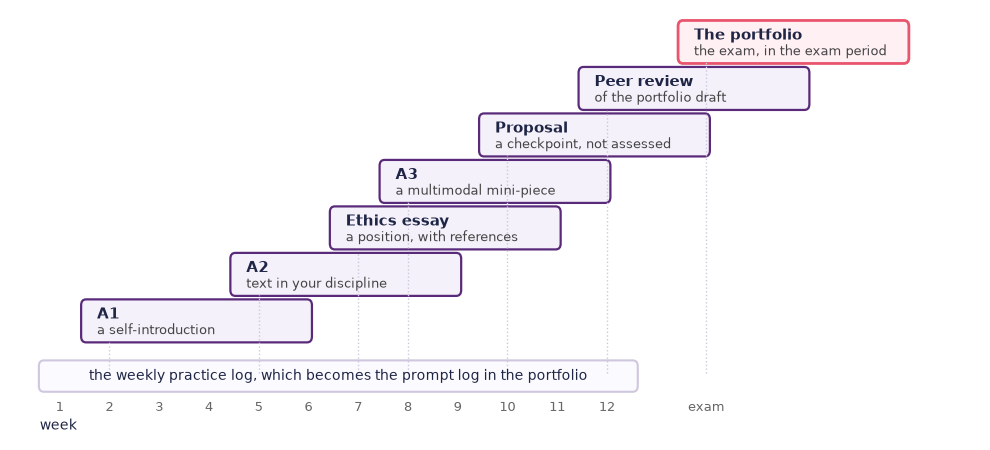
Figure: The four compulsory assignments and the two checkpoints across the semester, each one meant to make the next easier, with the weekly practice log running underneath all of them.
| Activity | Due | Form |
|---|---|---|
| A1, AI-augmented self-introduction | Week 2 | 1 page of text, 1 image, and a half-page reflection. |
| A2, AI-assisted text in your discipline | Week 5 | 800 to 1 200 words in a chosen genre (academic, creative, or popular science), with a 1 to 2 page reflection documenting prompts and edits. |
| Ethics essay | Set in week 3, due in week 7 | An argumentative essay of about 600 words (one page), on one of the five prompts set out in chapter 3, with at least three references. |
| A3, multimodal mini-piece | Week 8 | A 3 to 5 page (or slide) piece combining text and at least one other data type, with a reflection. |
| Proposal for the final piece | Week 10 | A checkpoint, not assessed: 1 to 2 pages plus a feasibility sketch, naming the shape of the final piece and how a reader moves through it in the exposition. |
Alongside the assignments you keep a weekly practice log, a short entry written as three paragraphs, Explore, Reflect, and Create, covering the tools used, the prompts, what you noticed, and one open question. Use the practice log template. It is not assessed on its own, but it is the raw material of the prompt log you hand in with the portfolio, and it is much harder to reconstruct afterwards than to keep.
Process memo
Each assignment is submitted with a short process memo answering, at minimum, two questions that recur all semester (adapted from the practice-based tradition at RITMO and from earlier creative-AI courses):
- Surprise. Where did the AI surprise you, pleasantly or unpleasantly, and what did that teach you about the tool?
- Will. Where did you exert your own creative will over the output, through prompt, edit, refusal, selection, or composition?
These two questions run through the whole course, and they are also the spine of the reflection you hand in with the portfolio. Answering them honestly, across everything you make, is what the assessment is looking for.
Reading list
The textbook itself is meant to carry the conceptual load of the course. The readings below are complements and deepenings. They include short essays you can read in an evening, books you can dip into around the chapter that needs them, and a few classics that anyone working with AI in cultural production should meet at least once. Many of them are openly available; the rest are in the UiO library.
You are not expected to read all of them. Pick one core title to read alongside the textbook over the semester, and dip into the supplementary list around the weekly topics that pull you.
Core curriculum
A short, deliberately broad list. Pick one to read in parallel with the textbook:
- Mitchell, M. (2019). Artificial Intelligence: A Guide for Thinking Humans. Farrar, Straus and Giroux Mitchell, 2019. — the most readable contemporary introduction to AI for a general audience, by an AI researcher who refuses to oversell. Best technical anchor.
- Hertzmann, A. (2018). “Can Computers Create Art?” Arts 7(2):18 Hertzmann, 2018. — short, open-access essay covering the philosophical question that hovers over the whole course. Best creative-AI anchor.
- Crawford, K. (2021). Atlas of AI: Power, Politics, and the Planetary Costs of Artificial Intelligence. Yale University Press Crawford, 2021. — structural critique of where the data, the labour, and the energy come from. Best critical anchor.
- Bridle, J. (2022). Ways of Being. Allen Lane Bridle, 2022. — contemporary, accessible reframe of “intelligence” beyond the human-vs-machine binary. Best forward-looking anchor.
If you read only one of these, pick Mitchell for the technical side or Hertzmann for the creative side. If you read two, pair one of those with Crawford or Bridle.
Supplementary reading by theme
The technical side, accessibly
Goodfellow, I., Bengio, Y., Courville, A. Deep Learning
— free online textbook. Chapter 1 is the readable introduction; the rest is a reference.
3Blue1Brown’s Neural Networks video series
— the best visual explanation of backpropagation and transformers.
The Hugging Face course
— free, code-first, beginner-friendly.
Russell, S., Norvig, P. Artificial Intelligence: A Modern Approach (4th ed.)
— the standard textbook for one of the standard “AI in general” courses. Browse, do not read cover-to-cover.
Art history, aesthetics, and creativity
Benjamin, W. (1935). The Work of Art in the Age of Mechanical Reproduction
— short, foundational essay on what mass reproduction does to art. The historical precedent the generative-AI debates rhyme with.
LeWitt, S. (1967). “Paragraphs on Conceptual Art”
— five pages; the early manifesto of “the idea is the machine that makes the art”. The conceptual lineage that flows directly into Creative AI.
Boden, M. A. (2004). The Creative Mind: Myths and Mechanisms (2nd ed.)
— definitive philosophical treatment of creativity; introduces the P-/H- and combinational / exploratory / transformational distinctions used throughout this book.
Runco, M. A., & Jaeger, G. J. (2012). “The Standard Definition of Creativity”
— four pages on the definition of creative work as original and effective, which the book adopts alongside Boden.
Kaufman, J. C., & Beghetto, R. A. (2009). “Beyond Big and Little: The Four C Model of Creativity”
— the scale from mini-c to Big-C; most creative AI use sits in the middle two steps.
McCorduck, P. (1991). AARON’s Code: Meta-Art, Artificial Intelligence, and the Work of Harold Cohen. W.,H. Freeman
— long-form study of Harold Cohen’s painting program; the original “creative AI” before the term existed.
Manovich, L. (2018). AI Aesthetics
— short, opinionated essays on what AI-mediated images look like culturally .
McCormack, J., et al. (2019). “Autonomy, Authenticity, Authorship and Intention in Computer Generated Art”
— useful, short philosophical paper on what authorship means when a system makes the work.
Critical, social, and political perspectives
Bender, E. M., Gebru, T., McMillan-Major, A., Shmitchell, S. (2021). “On the Dangers of Stochastic Parrots”
— the critical take on large language models you have to read.
Broussard, M. (2018). Artificial Unintelligence
— accessible critique from a former journalist turned data-science researcher.
Long, D., Magerko, B. (2020). “What is AI Literacy? Competencies and Design Considerations”
— defines AI literacy as a set of competencies a non-expert needs in order to use and evaluate these systems, and is the standard reference for the term.
O’Neil, C. (2016). Weapons of Math Destruction
— broader critique of algorithmic harm in society. Pre-dates the generative wave but still defines the vocabulary.
Pasquinelli, M. (2023). The Eye of the Master: A Social History of Artificial Intelligence
— readable cultural-historical lens on how AI got here.
Strubell, E., Ganesh, A., McCallum, A. (2019). “Energy and Policy Considerations for Deep Learning in NLP”
— the early empirical paper on the environmental cost of training.
Where it is going
Suleyman, M., Bhaskar, M. (2023). The Coming Wave
— accessible policy book by an industry insider with surprising clarity about risks.
Bridle, J. (2022). Ways of Being
— see “core curriculum” above; also reads beautifully against chapter 12 .
Salma, Z., Hijón-Neira, R., Pizarro, C. (2025). “Designing Co-Creative Systems: Five Paradoxes in Human–AI Collaboration”
— the source of the five-paradox framework introduced in chapter 3 .
Norway and the EU: institutional context
AI at UiO
— institutional resource page; the place to start when a question concerns the university itself.
The EU AI Act
and its official summary
— the binding legal frame for AI in Europe in 2026.
The NB AI Lab
at the National Library of Norway — Norwegian-language AI research, especially relevant for chapters 4 and 6 .
The RITMO Centre
— UiO research centre many of this course’s guest speakers come from.
Each weekly chapter ends with a Further reading section that adds chapter-specific suggestions on top of this list.
How to read this book
The chapters are roughly linear, but each is also self-contained. If you are new to the field, read them in order, since every chapter assumes the vocabulary of the ones before it. If you already have some background, skim chapter 2 and jump to the chapters on the medium you work in. Read the week’s chapter before the lecture, not instead of it.
Every chapter has the same eleven parts, so you always know where to look:
- A title and short description at the top, saying what the chapter covers.
- An opening paragraph naming the layer or layers the chapter works at, linked back to the five layers.
- Prose sections that explain ideas rather than document tools, with occasional Question boxes and short exercises where a two-minute experiment helps more than another paragraph.
- Dig deeper notes, in the chapters that have them, collapsed by default and holding the optional technical depth: equations, model details, and code listings. You can skip every one of them and still pass the course.
- A Research spotlight on one project from RITMO, the fourMs Lab, or the MishMash Centre, with a link and a sentence on how you could connect to it.
- This week’s lab: Explore, Reflect, Create, the plan for the 90-minute lab, with the timings described above.
- A critical look at one popular claim about Creative AI, worked through the claim, the evidence, the method, and the limits.
- A chapter summary in one paragraph, for revision.
- Five questions to test whether the chapter landed, worth answering before the lecture.
- Further reading, at least three items, every one with a link or a DOI.
- Explore interactively, links to the small web apps built for that chapter.
You are ready to begin.
Learn more
Two courses at the Department of Musicology sit close to this one, and all three can be taken in any order. None of them is a prerequisite for the others.
Music technology, sound analysis, and machine listening, taught from the same research environment. Its open textbook covers the hearing, motion, and machine-listening background that several chapters here touch on.
A hands-on course in sound synthesis, programming for music, and interactive systems, for students who want to build the instruments rather than prompt them.
- Long, D., & Magerko, B. (2020). What is AI Literacy? Competencies and Design Considerations. Proceedings of the 2020 CHI Conference on Human Factors in Computing Systems, 1–16. 10.1145/3313831.3376727
- Mitchell, M. (2019). Artificial Intelligence: A Guide for Thinking Humans. Farrar, Straus. https://melaniemitchell.me/aibook/
- Hertzmann, A. (2018). Can Computers Create Art? Arts, 7(2), 18. 10.3390/arts7020018
- Crawford, K. (2021). Atlas of AI: Power, Politics, and the Planetary Costs of Artificial Intelligence. Yale University Press. https://yalebooks.yale.edu/book/9780300264630/atlas-of-ai/
- Bridle, J. (2022). Ways of Being: Animals, Plants, Machines: The Search for a Planetary Intelligence. Allen Lane. https://www.penguin.co.uk/books/441267/ways-of-being-by-bridle-james/9780141994017