This chapter works at the culture layer of the five layers, and it sets up the spine of everything that follows. Before you open a single model, it is worth settling the terms: what creativity means, what artificial intelligence means, and what changes in writing, art, music, design, and education when the two meet.
In the autumn of 2022, a sentence typed into a web form could produce a photographic-looking image of a place that does not exist. A few months later, a paragraph could be drafted by a model that had read most of the open web. By 2024 there were short videos from text, songs from text, and code from text. By 2026 the tools are everywhere, in editors, in browsers, and in phones, and the question is no longer whether they can produce something but what you should do with them.
That last question is what the twelve weeks are for. This week is for the question that comes before it: what is Creative AI, and why is it now the subject of an undergraduate course open to students from every faculty at UiO?
Three slippery words
Each of the three words in Creative AI hides a long argument.
Creativity
Creativity is one of the oldest contested concepts in the humanities, and since the middle of the twentieth century it has also been a research topic in psychology. The starting point is usually dated to 1950, when J. P. Guilford used his presidential address to the American Psychological Association to complain that psychologists had almost entirely neglected creativity, and to argue that it could be measured Guilford, 1950. Guilford’s lasting contribution is the distinction between convergent thinking, which narrows down to the one correct answer, and divergent thinking, which opens out to many possible answers. The classic divergent thinking task asks for as many uses of a brick as you can think of, and scores the list for fluency, flexibility, originality, and elaboration. The same tasks are now run on language models. That is worth remembering when a headline reports that a chatbot “beat humans on a creativity test”: the test measures divergent thinking, which is one part of what creativity might mean.
A common working definition is that something is creative when it is novel and valuable in some context. Runco and Jaeger call this the standard definition and trace it back to the same period: creative work must be both original and effective Runco & Jaeger, 2012. Neither will do on its own. A random string of words is original but not effective, and a perfect copy of a masterpiece is effective but not original. Everything interesting lies in the two qualifiers, since originality and effectiveness are always judged by someone, in some context, against some history. A large part of this book is about who does the judging when a machine is involved.
The cognitive scientist Margaret Boden sharpens the “novel” half by asking novel to whom Boden, 2004:
- P-creativity (“psychological”): novel to the person who produced it.
- H-creativity (“historical”): novel to humanity.
A child’s first drawing of a face is P-creative; the invention of perspective in early Renaissance painting is H-creative.
Kaufman and Beghetto’s Four C model spreads the same idea across a scale with two more steps Kaufman & Beghetto, 2009:
- mini-c: the personally meaningful insight that comes with learning, such as a student noticing for the first time how a chord progression works.
- little-c: everyday creativity, such as a meal improvised from what is left in the fridge, or a well-judged birthday card.
- Pro-c: the creativity of trained professionals, such as a working designer, composer, or journalist, who produce competent new work every week without changing their field.
- Big-C: the eminent, historical creativity of the few whose work changes a field.
The model is useful here because most creative AI use sits at little-c and Pro-c. The public argument about whether a machine can ever be Big-C creative is a real argument. It says little, though, about what a designer does with an image model on a Tuesday afternoon, and that is where most of this book takes place.
Boden also distinguishes three kinds of creativity:
- Combinational: putting familiar ideas together in unfamiliar ways, as in collage or mash-up.
- Exploratory: moving around inside an existing conceptual space and discovering its corners.
- Transformational: changing the conceptual space itself, so that ideas previously impossible become thinkable.
Source
import numpy as np
from matplotlib.patches import Ellipse

import matplotlib.pyplot as plt
plt.rcParams.update({
    "font.size": 10,
    "axes.titlesize": 11,
    "axes.labelsize": 10,
    "xtick.labelsize": 9,
    "ytick.labelsize": 9,
    "legend.fontsize": 9,
    "figure.figsize": (10, 4),
    "figure.dpi": 100,
    "savefig.dpi": 150,
    "axes.spines.top": False,
    "axes.spines.right": False,
})

navy, purple, rose = "#1f2545", "#5a2a7a", "#e8556d"

fig, axes = plt.subplots(1, 3, figsize=(10, 4.0))
titles = ["Combinational", "Exploratory", "Transformational"]
glosses = ["two familiar regions joined",
           "an unreached corner of one region",
           "the region itself is redrawn"]

for ax, title, gloss in zip(axes, titles, glosses):
    ax.set_xlim(0, 10)
    ax.set_ylim(0, 10)
    ax.axis("off")
    ax.set_title(title, fontweight="bold", color=purple, pad=12)
    ax.text(5, 0.1, gloss, ha="center", va="bottom", fontsize=10, color="#444444")


def cloud(ax, centre, size, face="#f4f1fa", edge="#cfc7dd", style="-", lw=1.6):
    ax.add_patch(Ellipse(centre, size[0], size[1], facecolor=face,
                         edgecolor=edge, linewidth=lw, linestyle=style))


def dots(ax, points):
    points = np.array(points)
    ax.plot(points[:, 0], points[:, 1], "o", color=purple, markersize=5, zorder=3)


cloud(axes[0], (2.2, 5.4), (3.6, 3.4))
cloud(axes[0], (7.8, 5.4), (3.6, 3.4))
dots(axes[0], [(1.3, 5.9), (1.9, 6.3), (2.7, 6.1), (1.5, 4.9), (2.4, 4.6), (3.1, 5.2)])
dots(axes[0], [(6.9, 6.2), (7.6, 6.4), (8.5, 5.9), (7.0, 4.8), (8.0, 4.5), (8.7, 5.1)])
axes[0].text(2.2, 7.4, "one region", ha="center", va="bottom", fontsize=10, color=navy)
axes[0].text(7.8, 7.4, "another", ha="center", va="bottom", fontsize=10, color=navy)
a, b = (3.4, 5.0), (6.6, 5.8)
axes[0].plot([a[0], b[0]], [a[1], b[1]], color=rose, lw=2, zorder=4)
for point in (a, b):
    axes[0].plot(*point, "o", color=rose, markersize=6, zorder=5)
axes[0].plot(5.0, 5.4, "*", color=rose, markersize=18, zorder=6)
axes[0].text(5.0, 3.9, "the new thing", ha="center", va="top", fontsize=10, color=rose)

cloud(axes[1], (5.0, 5.8), (8.0, 5.2))
dots(axes[1], [(2.2, 5.9), (3.0, 7.0), (3.4, 4.9), (4.4, 7.3), (5.6, 7.2), (6.6, 7.0),
               (2.6, 4.6), (4.2, 4.2), (5.4, 4.4), (6.6, 4.6), (7.4, 6.9), (7.6, 5.2)])
walk = np.array([(3.0, 5.6), (4.0, 6.4), (5.0, 5.6), (6.0, 6.4), (7.0, 5.8), (8.2, 6.4)])
axes[1].plot(walk[:, 0], walk[:, 1], color=rose, lw=2, marker="o", markersize=4, zorder=4)
axes[1].plot(*walk[-1], "*", color=rose, markersize=18, zorder=5)
axes[1].text(5.0, 8.7, "one conceptual space", ha="center", va="bottom",
             fontsize=10, color=navy)
axes[1].text(8.6, 3.9, "a corner of it", ha="right", va="top", fontsize=10, color=rose)
axes[1].plot([8.2, 8.2], [6.0, 4.2], color=rose, lw=1.0, ls=":", zorder=4)

cloud(axes[2], (5.4, 5.4), (8.6, 5.8), "#fff0f3", rose, "-", 2.0)
cloud(axes[2], (3.4, 5.2), (4.2, 3.8), "#ffffff", "#8f8a9c", "--", 1.6)
dots(axes[2], [(2.6, 5.6), (3.3, 6.0), (4.0, 5.5), (2.8, 4.6), (3.7, 4.4), (4.3, 4.9)])
axes[2].text(3.4, 7.4, "the old space", ha="center", va="bottom", fontsize=10, color=navy)
axes[2].plot(7.6, 6.4, "*", color=rose, markersize=18, zorder=5)
axes[2].text(7.6, 5.9, "now thinkable", ha="center", va="top", fontsize=10, color=rose)
axes[2].text(7.0, 3.3, "the new space", ha="center", va="center", fontsize=10, color=rose)

plt.tight_layout()
plt.show()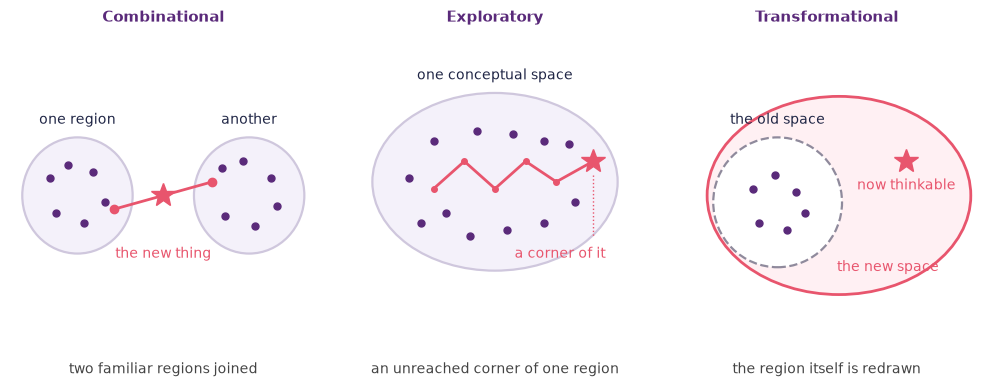
Figure: Combinational creativity joins two familiar regions, exploratory creativity reaches an unvisited corner of one region, and transformational creativity redraws the region so that new things become thinkable. The panels illustrate Boden’s three kinds Boden, 2004.
These three kinds return throughout the course. Generative systems are excellent at the first two and ambiguous about the third, and you can test that claim yourself in this week’s lab.
The neuroscientist David Eagleman and the composer Anthony Brandt describe the same ground from inside the brain, with three plainer verbs: bend, break, and blend Eagleman & Brandt, 2017. To bend is to reshape a known form, as when a melody is stretched or a portrait is distorted. To break is to cut a whole into pieces and reassemble them, as in a collage or a cubist painting. To blend is to merge two sources into one, as in a hybrid creature or a genre mash-up. The verbs line up only loosely with Boden’s kinds: blending is close to combinational creativity, while bending and breaking can be exploratory or transformational depending on how far they go. Eagleman and Brandt add a second point that matters for generative systems. A new work has to balance novelty against familiarity, since too little novelty bores and too much leaves the audience behind. A model trained to produce the most likely continuation of its training data starts at the familiar end of that balance, which is one reason so much generated work looks competent and unsurprising.
All of the definitions so far describe the work or the idea. Other traditions ask where creativity is located. Mel Rhodes sorted the research of his day into four strands: the person, the process, the product, and the press, the last being the environment that acts on the other three Rhodes, 1961. The four Ps remain a handy checklist for asking which of them a claim is about. Mihaly Csikszentmihalyi went further with his systems model, in which creativity is not in the person at all but in the interaction between three parts Csikszentmihalyi, 1996. The domain is the existing body of rules and works. The field is the gatekeepers, such as editors, curators, and teachers, who decide what enters the domain. The individual is whoever proposes a change. On that view a work becomes creative when the field accepts it, which is the same point the Colorado State Fair case at the end of this chapter turns on. When a system generates a thousand images and a person keeps three, the model has done the proposing and the person has acted as the field.
The word innovation is often used as if it meant the same thing, and it is worth keeping the two apart. Teresa Amabile defines innovation as the successful implementation of creative ideas within an organisation Amabile, 1988. Creativity, in that framing, is the idea and the work. Innovation is what happens when a company, a scene, or a public takes it up, and that step depends on money, timing, and power at least as much as on the idea. A generative model can raise the supply of original and effective ideas without touching any of the conditions that turn an idea into an innovation. Much of the disappointment with creative AI in workplaces comes from expecting the second when the tool only delivers the first.
Artificial intelligence
“AI” is even older as a label, since the Dartmouth workshop coined the phrase in 1956, and it is even harder to pin down. A pragmatic working definition is:
Artificial intelligence is the study and construction of systems that perform tasks otherwise considered to require human cognition.
That definition is deliberately slippery. As soon as a task becomes routine, as chess, optical character recognition, spam filtering, and speech-to-text all have, it tends to lose its “AI” status. Russell and Norvig describe four canonical framings: systems that think like humans, act like humans, think rationally, or act rationally Russell & Norvig, 2021.
For the purposes of this book, the AI in Creative AI almost always refers to machine-learned, often generative, systems based on neural networks trained on large datasets. Each of those words is unpacked in chapter 2.
Creative AI
Putting the two together gives a working definition of the field of study.
Notice three things about this definition.
- It is medium-agnostic. This is not another course on “AI for music” or “AI for writing”. The point of this generation of models is that the same architectures move between media.
- It treats AI as a material, not only as a topic. You will use these tools, not just read about them.
- It includes both the technical and the cultural side. Without the technical side, you cannot evaluate claims about what AI can or cannot do. Without the cultural side, you cannot evaluate what it should or should not be doing.
Three things the phrase can mean
The phrase creative AI is used for three different situations, and it helps to name them before the course leans on the term.
The first is a creative AI system: a system built to make or judge new things. The tradition runs from Harold Cohen’s drawing program and the evolutionary art of the 1990s, through the field of computational creativity, to the generative models of today. Here the question is what the system itself contributes, and chapter 12 returns to it under the name of the Lovelace objection.
The second is the creative use of a non-creative AI system. A speech recogniser, a translation engine, a face detector, or a chat assistant built for office work was not made for art, and artists use it anyway, often against its grain. The art-historical strand below is full of this move: a technology built for one purpose taken into the studio for another. Here the creativity sits with the person, and the system’s failures are as useful as its successes.
The third is creative AI applied to a non-creative topic. A generative model writes the minutes, drafts the grant application, or tidies the spreadsheet. The system is the same one that makes images and music, but the task is routine, and the questions change to reliability, cost, labour, and who checks the result. Much of what is sold as AI at work sits here.
Source
from matplotlib.patches import FancyBboxPatch

import matplotlib.pyplot as plt
plt.rcParams.update({
    "font.size": 10,
    "axes.titlesize": 11,
    "axes.labelsize": 10,
    "xtick.labelsize": 9,
    "ytick.labelsize": 9,
    "legend.fontsize": 9,
    "figure.figsize": (10, 4),
    "figure.dpi": 100,
    "savefig.dpi": 150,
    "axes.spines.top": False,
    "axes.spines.right": False,
})

navy, purple, rose = "#1f2545", "#5a2a7a", "#e8556d"

fig, ax = plt.subplots(figsize=(10, 4.4))

rows = [
    ("A creative AI system",
     ["A system built to\nmake or judge", "New work"],
     "the system is the\nclaimed author"),
    ("Creative use of\na system",
     ["A person", "A tool built for\nsomething else", "New work"],
     "the person supplies\nthe intent"),
    ("A routine task",
     ["A person", "The same\ngenerative model", "Minutes or a\nspreadsheet"],
     "cost and checking\nare the questions"),
]

left, right = 3.1, 8.5
for index, (name, boxes, note) in enumerate(rows):
    y = 3.3 - index * 1.55
    ax.add_patch(FancyBboxPatch((0.2, y - 0.05), 2.5, 1.05,
                                boxstyle="round,pad=0.02,rounding_size=0.12",
                                facecolor="#f4f1fa", edgecolor=purple, linewidth=1.8))
    ax.text(1.45, y + 0.475, name, ha="center", va="center", fontsize=11,
            fontweight="bold", color=navy)
    gap = 0.6
    width = (right - left - gap * (len(boxes) - 1)) / len(boxes)
    for position, title in enumerate(boxes):
        x = left + position * (width + gap)
        ax.add_patch(FancyBboxPatch((x, y - 0.05), width, 1.05,
                                    boxstyle="round,pad=0.02,rounding_size=0.12",
                                    facecolor="#fbfaff", edgecolor="#cfc7dd",
                                    linewidth=1.6))
        ax.text(x + width / 2, y + 0.475, title, ha="center", va="center",
                fontsize=10, color=navy, linespacing=1.5)
        if position < len(boxes) - 1:
            ax.annotate("", xy=(x + width + gap - 0.1, y + 0.475),
                        xytext=(x + width + 0.1, y + 0.475),
                        arrowprops=dict(arrowstyle="-|>", color=navy, lw=1.6))
    ax.text(8.85, y + 0.475, note, ha="left", va="center", fontsize=10,
            color=rose, linespacing=1.5)

ax.set_xlim(0, 11.9)
ax.set_ylim(-0.1, 4.6)
ax.axis("off")
plt.tight_layout()
plt.show()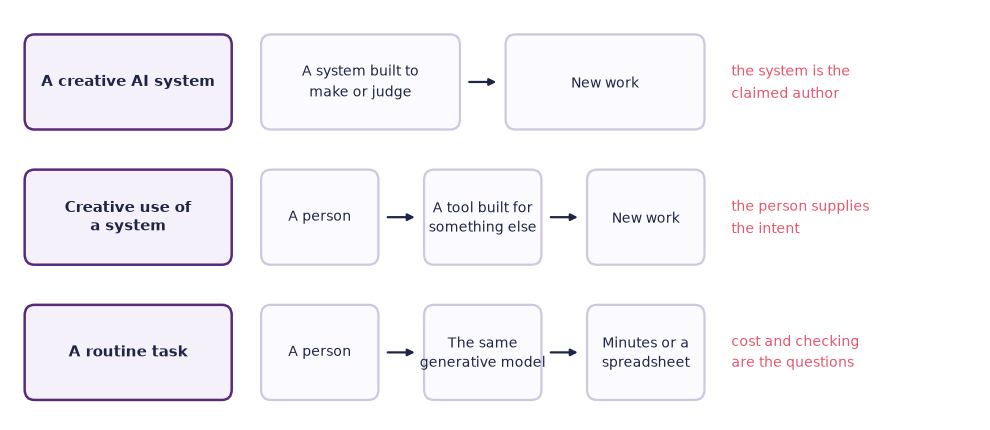
Figure: The phrase creative AI covers three situations, and they differ in where the creativity is placed rather than in which model is used.
This book works mostly in the first two situations, and it keeps the third in view because the same models, the same energy, and the same training data are involved. When a claim about creative AI sounds odd, ask which of the three it is about. Many disagreements dissolve at that point.
A short, opinionated history
The history of Creative AI is older than it looks, and it has two intertwined strands. One strand is the technology: rule-based programs, neural networks, transformers, diffusion. The other is the art-historical lineage of practices that welcomed chance, machines, systems, and procedures into the studio long before any of that technology existed.
Source
import matplotlib.pyplot as plt
plt.rcParams.update({
    "font.size": 10,
    "axes.titlesize": 11,
    "axes.labelsize": 10,
    "xtick.labelsize": 9,
    "ytick.labelsize": 9,
    "legend.fontsize": 9,
    "figure.figsize": (10, 4),
    "figure.dpi": 100,
    "savefig.dpi": 150,
    "axes.spines.top": False,
    "axes.spines.right": False,
})

navy, purple = "#1f2545", "#5a2a7a"
events = [
    (1957, "Illiac Suite"), (1973, "AARON"), (2014, "GANs"), (2015, "DeepDream"),
    (2017, "Transformer"), (2020, "Diffusion, GPT-3"), (2022, "Generative turn"),
    (2026, "Multimodal, agentic"),
]

fig, ax = plt.subplots(figsize=(10, 3.2))
ax.plot([-0.4, len(events) - 0.6], [0, 0], color=navy, lw=2)

for i, (year, name) in enumerate(events):
    high = i % 2 == 1
    ax.plot(i, 0, "o", markersize=11 if year == 2022 else 8, color=purple)
    ax.plot([i, i], [0, 0.36 if high else 0.18], color=purple, lw=1.2)
    ax.text(i, 0.44 if high else 0.26, name, ha="center", va="bottom",
            fontsize=11, color=navy)
    ax.text(i, -0.14, str(year), ha="center", va="top", fontsize=11,
            fontweight="bold", color=purple)

ax.text((len(events) - 1) / 2, -0.55,
        "From rule-based composition to multimodal agents (the spacing is not to scale)",
        ha="center", fontsize=10, color="#666666")

ax.set_xlim(-0.7, len(events) - 0.3)
ax.set_ylim(-0.75, 0.85)
ax.axis("off")
plt.tight_layout()
plt.show()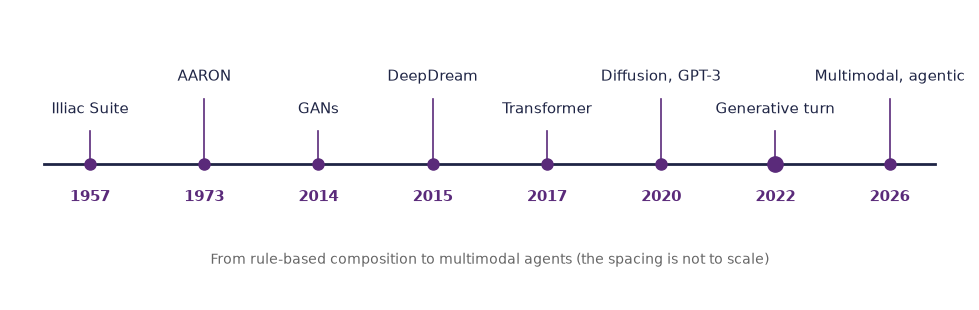
Figure: A simplified timeline of Creative AI milestones, running from rule-based composition in 1957 to the multimodal and agentic systems of the mid-2020s.
The art-historical strand
- 1910s, Dadaism. Tristan Tzara writes a poem by drawing words out of a hat. The point is precisely that chance is allowed into the work, and that the artist’s role becomes setting the conditions rather than choosing every word.
- 1950s and 1960s, concrete music, serialism, and Fluxus. Composers such as Iannis Xenakis use stochastic processes to compose pieces, and the Fluxus group treats instructions as the artwork, as in “Drip Music” and “Composition 1960 #7”. Concrete music builds pieces from recorded sound rather than from notated pitches, and serialism orders every parameter of a piece by a rule set in advance. The two Fluxus scores named here are each a single sentence telling a performer what to do.
- 1960s and 1970s, generative art. Vera Molnar, Manfred Mohr, and Frieder Nake produce drawings with algorithms and plotters, and Sol LeWitt writes that “the idea becomes a machine that makes the art” LeWitt, 1967.
- 1990s to 2010s, algorithmic art and creative coding. Casey Reas and Ben Fry release Processing, putting code in the hands of artists and designers, generative art becomes a stable category, and the lineage flows directly into the AI-augmented creative coding of chapter 9.
The turn to generative AI is therefore not a break with art history. It is the latest entry in a long tradition of artists delegating parts of the work to systems, procedures, and machines. What changes is how much gets delegated, how powerful the systems are, and who owns them.
The technical strand
- 1957, the Illiac Suite. Lejaren Hiller and Leonard Isaacson compose what is often cited as the first piece of music generated by a computer, using rules and pseudo-random choices.
- 1968, L-systems. Aristid Lindenmayer describes plant growth with rewriting rules, and the grammar later becomes a staple of generative graphics Prusinkiewicz & Lindenmayer, 1990.
- 1973 onwards, AARON. The artist Harold Cohen develops AARON, a rule-based system that draws and later paints autonomously McCorduck, 1991.
- 1980s, Markov models and expert systems. Statistical and rule-based methods are used in music composition, notably by David Cope, in story generation with systems such as TALE-SPIN and MINSTREL, and in design.
- 1986, biomorphs. Richard Dawkins’s Blind Watchmaker program lets a user breed line drawings by picking favourites, the first widely seen interactive evolution Dawkins, 1986.
- 1991, evolved images. Karl Sims evolves images, and later virtual creatures, with genetic algorithms, bringing evolutionary art to SIGGRAPH, the annual computer-graphics conference where the field shows its new work Sims, 1991.
- 2014, generative adversarial networks. Goodfellow and colleagues introduce a way to train generators by pitting them against discriminators Goodfellow et al., 2014. This starts the first wave of neural Creative AI.
- 2015, DeepDream. Researchers turn an image classifier inside out and produce hallucinated, dog-eyed pictures that circulate widely. For the first time, a broad public sees what a neural network responds to.
- 2017, the transformer architecture. Vaswani and colleagues publish “Attention Is All You Need” Vaswani et al., 2017. Within a few years it becomes the dominant architecture for language, image, audio, and code models.
- 2020, diffusion and large language models. Diffusion models mature Ho et al., 2020 and large language models pass the threshold where they become useful for general writing Brown et al., 2020.
- 2022, the generative turn. Open-weight image models, commercial text-to-image services, and a conversational assistant with a free web interface all land within a few months, and generative AI moves from research labs into the hands of millions of users.
- 2023, multimodality and scale. The same model families begin to handle text, image, audio, and video together, run on phones, and appear inside operating systems, browsers, and creative software.
- 2024 and 2025, reasoning models and agents. Models trained to spend extra computation on intermediate steps before answering are wired into tool-using loops that carry out tasks over many steps, the subject of chapter 11.
- 2025 and 2026, world models and embodied AI. Systems that simulate a navigable environment rather than a single clip, and models placed in robots and other physical devices, move from demonstration to early product, as chapters 7 and 12 discuss.
A plotter draws an AARON picture in the gallery, in the Whitney Museum of American Art’s livestream from its Harold Cohen exhibition.
Two patterns are worth pulling out of this list. First, the medium-specific waves are converging: by 2024 one model family could write, draw, code, and speak. Second, public visibility lags research by years: every sudden public moment, in 2015 as in 2022, sits on top of a decade of slower academic and industrial work. Neither rules nor evolution disappeared when learning arrived, since both are still used to make work today, which is why chapter 2 sets the three side by side.
Three concepts that thread through the course
Out of these two strands, three concepts run through every remaining chapter.
- Intentionality. Why are you making this? A model can produce a thousand variations cheaply. The interesting question is which of them you meant.
- Aesthetic control. How precisely can you steer the system towards the artefact you actually want? Most of the technical content of this course, from prompts and conditioning to sampling, editing, reference images, and agents, is in service of this single question.
- Ethical authorship. Who is the author when a model trained on millions of other people’s work assists you? What do you owe them, your audience, and yourself in how you describe the work?
Source
from matplotlib.patches import FancyBboxPatch

import matplotlib.pyplot as plt
plt.rcParams.update({
    "font.size": 10,
    "axes.titlesize": 11,
    "axes.labelsize": 10,
    "xtick.labelsize": 9,
    "ytick.labelsize": 9,
    "legend.fontsize": 9,
    "figure.figsize": (10, 4),
    "figure.dpi": 100,
    "savefig.dpi": 150,
    "axes.spines.top": False,
    "axes.spines.right": False,
})

navy, purple, rose = "#1f2545", "#5a2a7a", "#e8556d"

fig, ax = plt.subplots(figsize=(10, 4.6))

vertices = {
    "Intentionality": (6.0, 4.15, "Why are you making this?"),
    "Aesthetic control": (2.0, 0.95, "How precisely can you steer it?"),
    "Ethical authorship": (10.0, 0.95, "Who else is in the work?"),
}
points = {name: (x, y) for name, (x, y, _) in vertices.items()}
order = list(vertices)

for a, b in zip(order, order[1:] + order[:1]):
    ax.plot([points[a][0], points[b][0]], [points[a][1], points[b][1]],
            color="#cfc7dd", lw=2, zorder=1)

edges = [
    ((6.0, 4.15), (2.0, 0.95), "steering towards\nwhat you meant", "right"),
    ((2.0, 0.95), (10.0, 0.95), "whose material the steering uses", "centre"),
    ((10.0, 0.95), (6.0, 4.15), "what you say you did", "left"),
]
for (x1, y1), (x2, y2), text, side in edges:
    mx, my = (x1 + x2) / 2, (y1 + y2) / 2
    offset = {"right": (-0.45, 0.1), "left": (0.45, 0.1), "centre": (0.0, -0.45)}[side]
    ax.text(mx + offset[0], my + offset[1], text,
            ha={"right": "right", "left": "left", "centre": "center"}[side],
            va="center", fontsize=10, color="#444444")

for name, (x, y, question) in vertices.items():
    ax.add_patch(FancyBboxPatch((x - 1.55, y - 0.5), 3.1, 1.0,
                                boxstyle="round,pad=0.02,rounding_size=0.14",
                                facecolor="#f4f1fa", edgecolor=purple,
                                linewidth=1.8, zorder=2))
    ax.text(x, y + 0.16, name, ha="center", va="center", fontsize=11,
            fontweight="bold", color=navy, zorder=3)
    ax.text(x, y - 0.2, question, ha="center", va="center", fontsize=10,
            color="#444444", zorder=3)

ax.text(6.0, 2.05, "the work", ha="center", va="center", fontsize=11,
        color=rose, fontweight="bold")

ax.set_xlim(0, 12)
ax.set_ylim(0.1, 5.1)
ax.axis("off")
plt.tight_layout()
plt.show()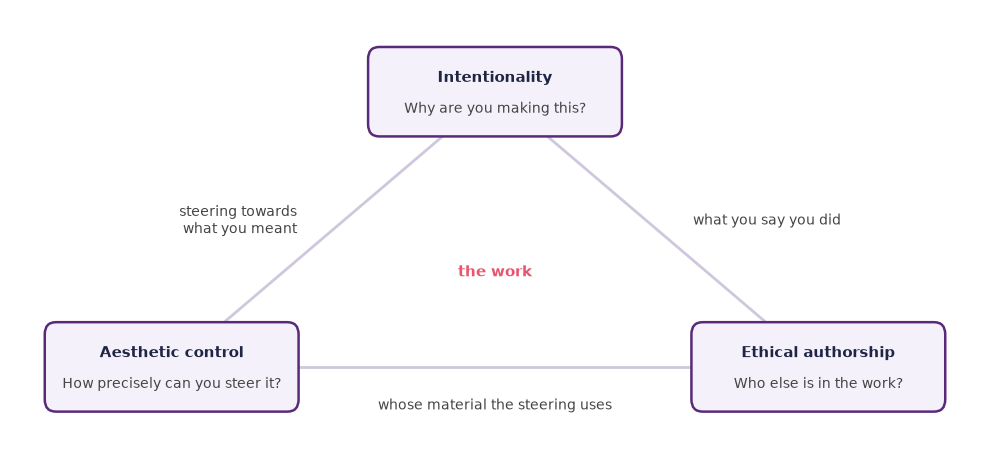
Figure: The three concepts sit at the corners of the same piece of work, and each edge names what is at stake between one corner and the next.
These three words return in every chapter, and almost verbatim in the process memo you write with each assignment.
Five layers
A claim about Creative AI is easier to judge once you know which part of the chain it is about, from the material a system was built on to the world its outputs eventually land in. The overview names five such layers, and it pays to carry them with you from week 1.
- Data. What went into the system: which material, gathered from whom, with what consent and whose labour.
- Model. What the system can do and why: architecture, training, sampling, and the limits that follow from them.
- Interface. How you steer it: prompts, briefs, controls, tools, agents, and bodies.
- Practice. How you make good work with it: workflow, craft, iteration, documentation, and collaboration.
- Culture. What changes when the work reaches the world: authorship, aesthetics, law, economy, and environment.
Source
from matplotlib.patches import FancyBboxPatch

import matplotlib.pyplot as plt
plt.rcParams.update({
    "font.size": 10,
    "axes.titlesize": 11,
    "axes.labelsize": 10,
    "xtick.labelsize": 9,
    "ytick.labelsize": 9,
    "legend.fontsize": 9,
    "figure.figsize": (10, 4),
    "figure.dpi": 100,
    "savefig.dpi": 150,
    "axes.spines.top": False,
    "axes.spines.right": False,
})

navy, purple, rose = "#1f2545", "#5a2a7a", "#e8556d"
layers = [
    ("Data", "what went into it, from whom, with what consent"),
    ("Model", "what the system can do, and why"),
    ("Interface", "how it is steered"),
    ("Practice", "how somebody makes good work with it"),
    ("Culture", "what changes when the work reaches the world"),
]

fig, ax = plt.subplots(figsize=(10, 4.4))
for i, (name, gloss) in enumerate(layers):
    top = i == len(layers) - 1
    y = 0.6 + i * 1.0
    ax.add_patch(FancyBboxPatch((1.6, y), 9.6, 0.85,
                                boxstyle="round,pad=0.02,rounding_size=0.12",
                                facecolor="#fff0f3" if top else "#f4f1fa",
                                edgecolor=rose if top else purple, linewidth=1.8))
    ax.text(2.0, y + 0.425, name, va="center", fontsize=11, fontweight="bold", color=navy)
    ax.text(4.4, y + 0.425, gloss, va="center", fontsize=11, color="#444444")

ax.annotate("", xy=(1.1, 5.5), xytext=(1.1, 0.7),
            arrowprops=dict(arrowstyle="-|>", color="#8a8598", lw=2))
ax.text(0.65, 3.05, "from the material to the world", rotation=90,
        ha="center", va="center", fontsize=10, color="#444444")
ax.text(1.6, 5.75, "A claim is easier to judge once you know which layer it is about",
        fontsize=11, fontweight="bold", color=purple)

ax.set_xlim(0, 11.6)
ax.set_ylim(0.2, 6.3)
ax.axis("off")
plt.tight_layout()
plt.show()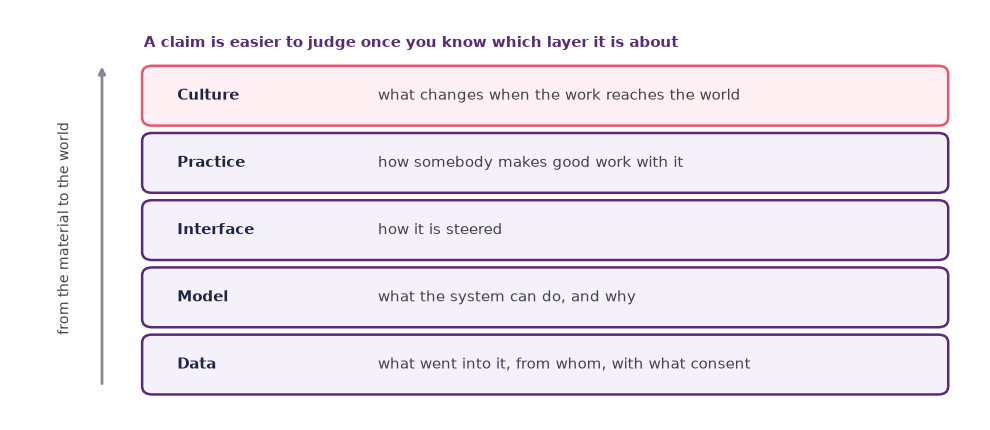
Figure: The five layers run from the material a system was built on, at the bottom, to the world its outputs land in, at the top, and a claim belongs to one of them.
The MishMash Centre for AI and Creativity sorts the same territory into three perspectives, machines, humans, and society, which map roughly onto the model layer, the interface and practice layers, and the culture layer.
Every chapter opens by naming the layer or layers it works at, so that you always know which questions are in play. Try the habit on a claim you have already met. “The model is not really creative” is a model-layer claim and needs evidence about what the system does; “this image is not really art” is a culture-layer claim and needs an argument about how a community values work. Answering one with the other is the most common way these discussions go wrong.
What is not Creative AI
To sharpen the working definition above, here are a few things this course is not about.
- AI in general. The course does not survey self-driving cars, medical diagnosis, or fraud detection.
- The mathematics of deep learning. A few equations help and the book shows them, but you do not need to derive backpropagation to pass the course.
- Forecasting. Chapter 3 uses scenarios as a way to ask questions, not as predictions.
The course does, however, take seriously:
- Critical perspectives from the humanities and social sciences on what these systems do to labour, copyright, attention, education, and the environment Crawford, 2021Bender et al., 2021O'Neil, 2016.
- Hands-on use of the systems, so that the criticism is grounded in experience.
This week’s lab: Explore, Reflect, Create
This first lab gets you over the activation energy of opening accounts, running generations, and writing the first entry in the practice log you will keep all semester.
Explore (about 30 min)
- Pick one text tool and one image tool from the tools page. Make a free account if you need one, and note the tool name and the date in your log.
- Same brief, two media. Write a single short brief of one or two sentences for a small creative task, for example a flyer for a student concert with a jazz trio. Use the text tool to draft the flyer text and the image tool to draft the visual.
- Vary one thing. Run each generation again with exactly one thing changed: a different style word, a different tone, a longer or shorter prompt. Save both versions of both outputs, and note where the tool surprised you.
Reflect (about 15 min)
Work in pairs, then in plenary. This is a discussion, not a writing block.
- Read out the one-sentence definition of Creative AI you wrote at the start of this chapter, and compare it with the working definition above. What did you leave out, and what did you include that the working definition does not?
- Look at your partner’s four outputs. Which of Boden’s three kinds of creativity, combinational, exploratory, or transformational, would you say each one shows? Then ask Eagleman and Brandt’s question: is it bending, breaking, or blending, and how far has it moved from the familiar?
- Close the round by stating one intention aloud: one thing you now intend to make in the next 45 minutes.
Create (about 45 min)
- Assemble one artefact from your variations: a single flyer combining your best image with your best caption, or a two-image diptych with one shared title. Aim for something you would be willing to show other people.
- Make at least three decisions the model did not make for you, whether by cropping, rewriting, reordering, or refusing an output, and note them.
- Pair up and present each other’s artefacts to a third student in the last 15 minutes. We collect the surprises on the board.
At home, write the first entry in your practice log: three short paragraphs, one each on Explore, Reflect, and Create, using the practice log template. What this lab hands on to A1, the AI-augmented self-introduction due in week 2, is the prompts you saved, the workflow you followed, and one text tool and one image tool you now know how to steer. A1 therefore starts from a tried process rather than a blank page, and like every compulsory assignment it comes back, revised after feedback, in your portfolio.
A critical look: did an AI win the Colorado State Fair?
The claim. In August 2022 an image made with a generative system won a state art prize, and the story went around the world as “AI beats human artists” Roose, 2022.
The evidence. Jason Allen entered a work titled “Théâtre D’opéra Spatial” in the digital arts and digitally manipulated photography category of the Colorado State Fair, and took first place. The entry was made with a text-to-image tool, followed by many hours of prompting, selecting among outputs, and editing in an image editor. That category is for work whose medium is digital tools, manipulated photographs included, rather than for drawing or painting by hand. The judges said afterwards that they would have given the prize even knowing how the work was made Roose, 2022.
The method. This was a juried competition, not an experiment. One small category, one panel, one afternoon, and no blind comparison of AI-made against human-made entries. Nothing was measured, and nothing was controlled. A different jury, or the same jury in a different category, could easily have decided otherwise.
The limits. The result tells you about that jury and that category. It does not tell you that machines out-draw people, and it cannot, because no such comparison was run. The genuinely interesting question the case raises is a different one: who was the author of the winning work, the person who wrote and selected and edited for many hours, the model, or the many artists whose images trained it? Chapter 3 takes that question up in earnest.
- Guilford, J. P. (1950). Creativity. American Psychologist, 5(9), 444–454. 10.1037/h0063487
- Runco, M. A., & Jaeger, G. J. (2012). The Standard Definition of Creativity. Creativity Research Journal, 24(1), 92–96. 10.1080/10400419.2012.650092
- Boden, M. A. (2004). The Creative Mind: Myths and Mechanisms (2nd ed.). Routledge. https://www.routledge.com/9780415314534
- Kaufman, J. C., & Beghetto, R. A. (2009). Beyond Big and Little: The Four C Model of Creativity. Review of General Psychology, 13(1), 1–12. 10.1037/a0013688
- Eagleman, D., & Brandt, A. (2017). The Runaway Species: How Human Creativity Remakes the World. Catapult. https://www.penguinrandomhouse.com/books/673536/the-runaway-species-by-david-eagleman/
- Rhodes, M. (1961). An Analysis of Creativity. The Phi Delta Kappan, 42(7), 305–310. https://www.jstor.org/stable/20342603
- Csikszentmihalyi, M. (1996). Creativity: Flow and the Psychology of Discovery and Invention. HarperCollins.
- Amabile, T. M. (1988). A Model of Creativity and Innovation in Organizations. Research in Organizational Behavior, 10, 123–167.
- Russell, S., & Norvig, P. (2021). Artificial Intelligence: A Modern Approach (4th ed.). Pearson. https://www.pearson.com/en-us/subject-catalog/p/artificial-intelligence-a-modern-approach/P200000003500
- LeWitt, S. (1967). Paragraphs on Conceptual Art. Artforum, 5(10), 79–83. https://www.artforum.com/print/196706/paragraphs-on-conceptual-art-36719
- Prusinkiewicz, P., & Lindenmayer, A. (1990). The Algorithmic Beauty of Plants. Springer. 10.1007/978-1-4613-8476-2
- McCorduck, P. (1991). AARON’s Code: Meta-Art, Artificial Intelligence, and the Work of Harold Cohen. W.\,H. Freeman. https://archive.org/details/aaronscodemetaar0000mcco
- Dawkins, R. (1986). The Blind Watchmaker. Longman. https://www.worldcat.org/isbn/0582446945
- Sims, K. (1991). Artificial evolution for computer graphics. ACM SIGGRAPH Computer Graphics, 25(4), 319–328. 10.1145/127719.122752
- Goodfellow, I. J., Pouget-Abadie, J., Mirza, M., Xu, B., Warde-Farley, D., Ozair, S., Courville, A., & Bengio, Y. (2014). Generative Adversarial Nets. Advances in Neural Information Processing Systems (NeurIPS). https://arxiv.org/abs/1406.2661