Schaeffer cards (TARTYP & TARSOM)
Pierre Schaeffer's Traité des objets musicaux summarises its analysis in two tables, and musiscape renders a per-track card for each:
schaeffer—the typology (TARTYP)
Each track is segmented into onset-bounded sound objects and every object classified on a simplified TARTYP grid: mass N (tonic) / Y (variable) / X (complex) from spectral flatness and centroid drift, facture held / impulse (′) / iteration (″) from duration and 4–20 Hz envelope modulation. The card draws the objects on three mass lanes (ticks = impulses, hatching = iterations, solid blocks = held) with a TARTYP duration-share grid inset:
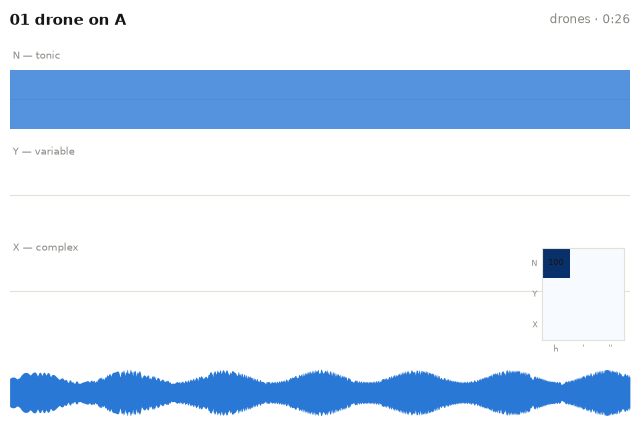
Segmentation and thresholds are shared with
ambiscape.music.tartyp_profile, so the cards always agree with the
statistics. The simplified grid covers Schaeffer's central balanced
objects; the full table's redundant and eccentric classes (homogeneous
drones, pedals, large objects) are a planned extension.
tarsom—the morphology (TARSOM)
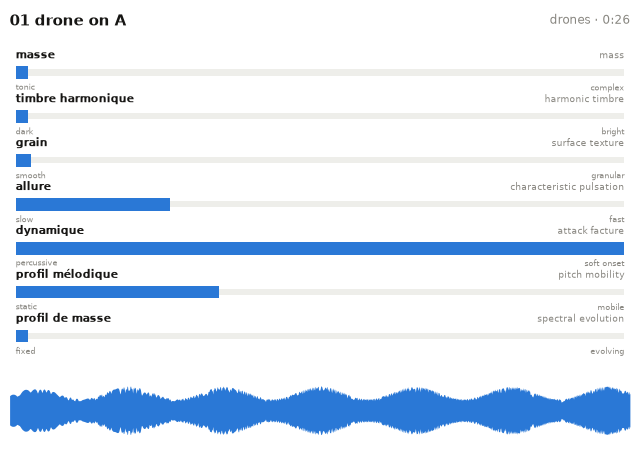
The Tableau récapitulatif du solfège des objets musicaux summarises seven morphological criteria. The card shows the track's measured position on each as a centre–periphery rose. Every criterion is a sector radiating from the centre pole (tonic, dark, smooth, slow, percussive, static, fixed) toward its periphery pole, so a track's morphology reads as one shape:
| Criterion | Proxy | Scale |
|---|---|---|
| masse | median spectral flatness | tonic ↔ complex |
| timbre harmonique | spectral centroid | dark ↔ bright |
| grain | 20–100 Hz envelope modulation share | smooth ↔ granular |
| allure | 0.5–8 Hz envelope modulation peak | slow ↔ fast |
| dynamique | median onset-to-peak attack time | percussive ↔ soft onset |
| profil mélodique | dominant-pitch changes per second | static ↔ mobile |
| profil de masse | spectral-flatness evolution | fixed ↔ evolving |
Honesty
These are signal proxies for aural categories. Schaeffer's typology and morphology are acts of reduced listening; a threshold on spectral flatness is not. The proxies were calibrated on tonal instrumental corpora, and the scales on the TARSOM card reflect that calibration. In the tradition of Lasse Thoresen's aural sonology—where the analyst hears and then notates—treat these cards as machine-made drafts for the ear: a place to start listening, and to disagree with.