musiscape
A Python toolbox for analysing large music collections and long music recordings.
Existing tools answer the question "what is this track?". musiscape answers two others. For a collection, it shows how albums differ, which tracks resemble which, how internally consistent each album is, where the outliers live, and what categories the corpus falls into. For a long recording such as a concert, it finds the songs inside it first, so the same tools apply to a live set. Every number it reports carries a musical name.
musiscape is a sibling of ambiscape (soundscapes) and micromotion (human micromotion). Each runs on its own, and musiscape needs neither installed.
Where a measure appears in more than one toolbox it has one owner and one
implementation, so combining them or moving between them gives the same
number. Circular statistics belong to micromotion: pulse clarity for
rubato-heavy material where BPM fails, tonal centres on the circle of
fifths, and the Rayleigh test all come from there. The object-level
TARTYP and TARSOM proxies live here, in musiscape.music.
What it does
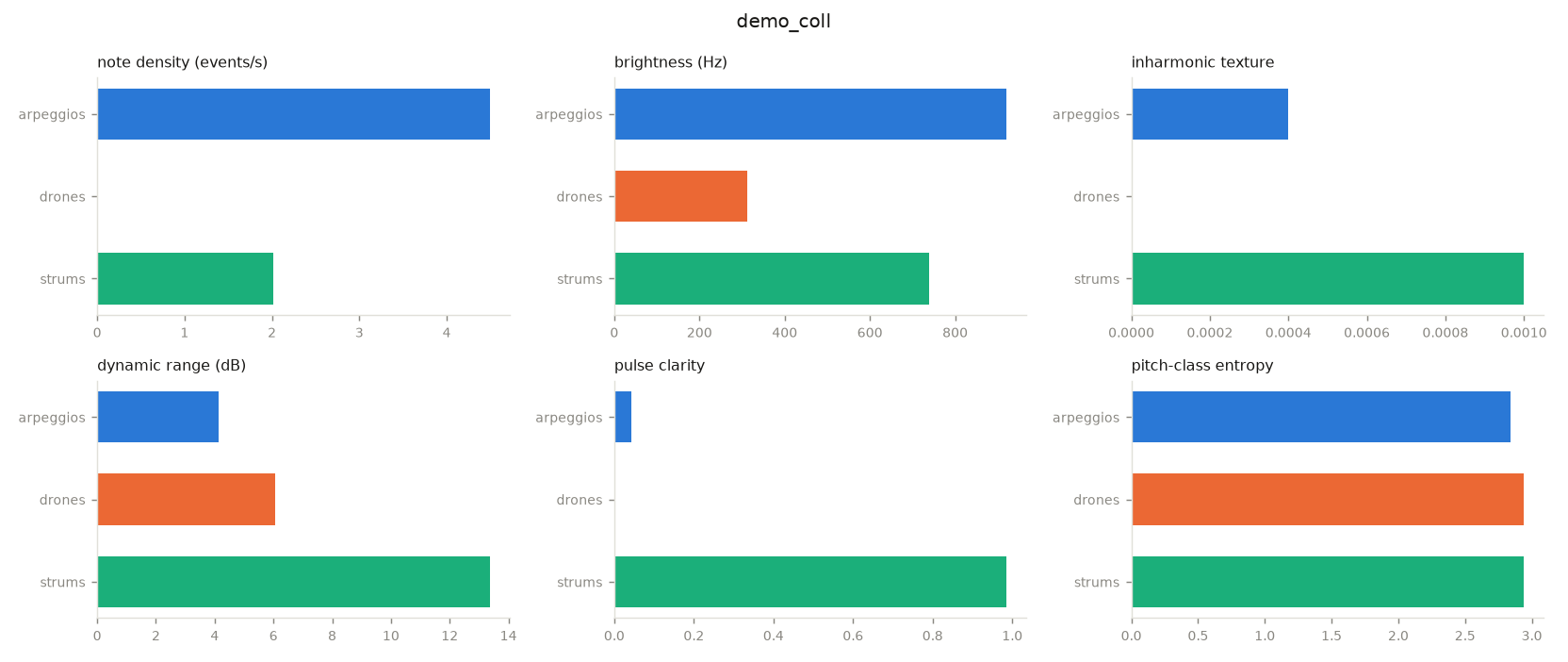
- Fingerprints—per-album profiles of note density, brightness, inharmonic texture, dynamics, pulse clarity and pitch-class entropy.
- Landscape—every track as a point in a PCA of the standardised features, plus an album-affinity matrix and internal-consistency scores.
- Categories—k-means clusters that describe themselves through signed feature z-scores ("sparse, dark, drone-like", rather than just "cluster 3").
- Thumbnails—seventeen per-track visual card styles, from spectrograms through Freesound-style waveforms, tonality vinyl discs, Sapp keyscapes and Shape-of-Song arcs, to Schaefferian TARTYP timelines and TARSOM morphology roses. See the gallery.
- Posters—the whole collection as stacked harmony barcodes or a grid of tonality discs.
- Sonic thumbnails—a ~12-second audio summary per track, plus one medley file per album, for browsing a collection by ear.
- Report—one command renders everything into a per-collection
README.md.
Honesty
Features are interpretable signal proxies, a deliberate trade against embedding models: weaker raw similarity, but every axis can be argued about. Key estimates are Krumhansl–Schmuckler correlations (indicative for drones); pulse clarity conflates slow tempo drift with rubato; Schaeffer classes are corpus-calibrated proxies for aural categories. Treat every category and card as a draft for listening, not a verdict.
Citing
Jensenius, A. R. (2026). musiscape: A Python toolbox for analysing large music collections and long music recordings [Computer software]. Zenodo. https://doi.org/10.5281/zenodo.21964192
That is the concept DOI and it always resolves to the newest version. Where the exact behaviour matters, add the version you ran; every release has its own DOI, listed on the Zenodo record.